Skip to main content Skip to navigation
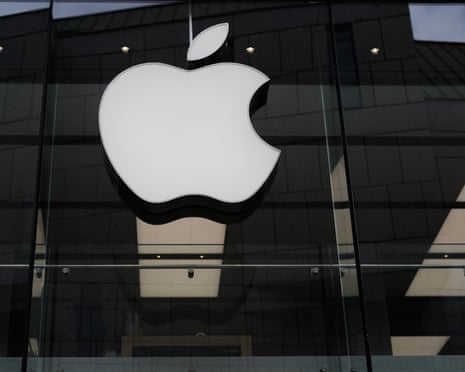
Apple’s shares hit a session high of $342.89 on Tuesday. Photograph: Matthias Schräder/AP
Apple’s shares hit a session high of $342.89 on Tuesday. Photograph: Matthias Schräder/AP
Apple becomes second ever $5tn company as investors flee AI stocks
Share price rally driven by strong product demand as well as decision to sit out AI spending race, amid wider tech sell-off
Apple has become only the second company to pass the $5tn valuation mark, as it benefited from investors fleeing AI and semiconductor stocks amid a wider tech sell-off.
The iPhone maker’s shares hit a session high of $342.89 on Tuesday, giving it a market capitalisation of $5.04tn (£3.78tn), then eased back to 0.83% up at $339.71 – just below the $5tn mark.
Apple became the world’s most valuable company earlier this month, overtaking the chip giant Nvidia, which had been at the top since June 2025 and became the first company ever to breach the $5tn threshold last October.
The US consumer electronics company’s rally has been driven as much by strong demand for its products as its decision to sit out the AI spending race that is sapping cash flows at big tech rivals.
Its fresh valuation high came amid an intensifying sell-off of AI stocks around the world amid rising concerns about AI companies’ borrowing to fund datacentre expansion.
US chip stocks extended their recent losses when Wall Street opened on Tuesday, with Intel, Advanced Micro Devices, Sandisk, Western Digital Corp and Seagate Technology all down by more than 4%.
The Nasdaq 100 index of leading tech stocks fell by as much as 1.8% at one point, meaning since its early June record high it had fallen more than 10% – the technical definition of a market correction.
Meanwhile South Korea’s stock market slid to its lowest level since mid-April, with semiconductor companies SK Hynix and Samsung Electronics falling by more than 10%.
Analysts attributed the sell-off to renewed worries over AI investment spending, and competition from cheaper Chinese companies, after a report by the Information that China had begun mass production of homegrown deep ultraviolet (DUV) chip-making tools.
“We believe the market was likely spooked by the progress of China’s chip-making equipment capabilities, and was worried that this progress would threaten the competitive position of global chip making and chip equipment leaders,” said Jing Jie Yu, an equity analyst at Morningstar, adding that the sell-off was “largely a kneejerk reaction and overdone”.
On Monday, shares in the Chinese memory chip maker CXMT rose by 466% when it floated on the Shanghai stock exchange, underlining China’s drive to create its own AI supply chain.
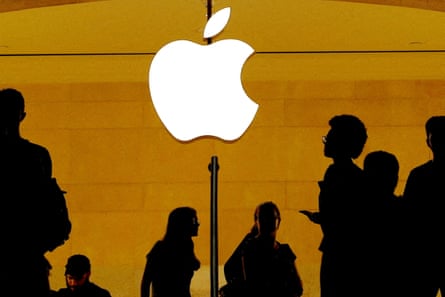
Apple’s decision to hold iPhone prices steady, despite increases last month for MacBooks and iPads, has bolstered demand. Photograph: Lucas Jackson/Reuters
Investors may also be growing jittery about the “circular funding” at the heart of the AI industry, through which artificial intelligence firms finance one another.
By contrast Apple’s difficulties in developing in-house AI models have meant it has had to rely on Google’s technology to power new services such as a revamped Siri. That has spared it the hefty infrastructure costs that have left big tech investors wary of the payoff from surging datacentre investments.
skip past newsletter promotion
after newsletter promotion
Apple’s decision to hold iPhone prices steady last month when it unveiled increases for MacBooks and iPads has also bolstered demand as buyers scooped up the company’s flagship device ahead of expected price hikes later this year, analysts have said.
To aid demand, Apple on Tuesday also launched a device leasing programme in the US through the payments firm Klarna, under which monthly payments start at $17.99 for an iPhone, $11.99 for an Apple Watch or iPad, and $24.99 for a Mac.
“Apple has resisted the AI spending race, betting that customer experience – not infrastructure investment – will ultimately determine the winners,” said Dipanjan Chatterjee, a vice-president and principal analyst at Forrester. “The new leasing programme is a clever response: it doesn’t reduce the price of an iPhone, but it changes how consumers perceive the cost by replacing sticker shock with a predictable monthly payment.”
Including session gains, Apple stock has jumped 24% so far this year, widely outperforming the other six of the “Magnificent Seven” cohort of US technology stocks.
Apple is to report its third-quarter earnings after the market close on Thursday, with analysts expecting a more than 15% jump in quarterly revenue from a year earlier.
Reuters contributed to this report
Explore more on these topics
UK iPhone users face over-18 age check to use services after update

Apple and Google pledge not to discriminate against third-party apps in UK deal

Apple reportedly cuts production of Vision Pro headset after poor sales
Apple seeks to appeal against £1.5bn ruling it overcharged UK customers
Siri-us setback: Apple’s AI chief steps down as company lags behind rivals

Ducking annoying: why has iPhone’s autocorrect function gone haywire?

Apple hits $4tn market value as new iPhone models revitalize sales
Apple and Google face enforced changes over UK mobile phone dominance

iOS 26 release: everything you need to know about Apple’s Liquid Glass updates