
Text settings
Story text
SizeSmallStandardLargeWidth *StandardWideLinksStandardOrange
\* Subscribers only
Minimize to nav
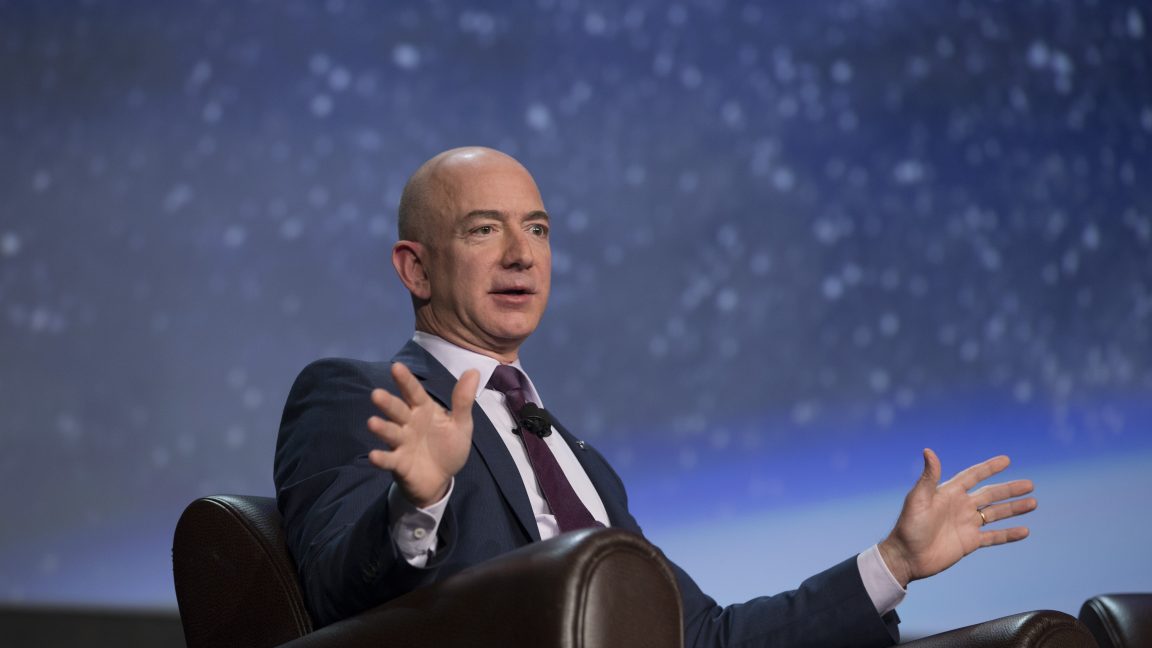
The rocket company founded by Jeff Bezos, Blue Origin, is raising private capital, the DealBook newsletter reported early Wednesday.
According to the publication, the company is raising $10 billion, leading to a valuation of $130 billion. Coatue Management, a big asset manager, is expected to lead with a $4 billion commitment. Another $4 billion is expected to come from large institutional investors. And Bezos will contribute an additional $2 billion.
Founded in 2000, Blue Origin is seeking to become a global leader in spaceflight, developing a line of super heavy lift rockets, lunar landers, and plans for two megaconstellations. It is seeking to compete in the same areas—launch, telecommunications, data centers from space—as SpaceX.
However, unlike SpaceX, which began with a relatively small investment from Elon Musk and then supported its operations through government and commercial contracts, private investment, and loans, Blue Origin has subsisted almost entirely on the largesse of Bezos. He now invests several billion dollars a year into the sprawling company with major operations in Washington, Alabama, and Florida.
In March, Ars predicted that Bezos would likely take on outside investors in the near future in order to compete financially with SpaceX. Even so, the numbers reported by DealBook are dwarfed by the $85 billion that SpaceX raised through its initial public offering process earlier this year, and its valuation of approximately $2 trillion. Blue Origin also needs such a plan to compete with the lucrative stock options offered by SpaceX to its employees.
Plans set back by pad explosion
During the spring and summer months this year, multiple sources told Ars that Bezos was involved in fundraising activities for Blue Origin. However, those plans were temporarily set back in late May when the company’s flagship rocket, New Glenn, exploded in Florida and took out its only launch pad.
Since then, Bezos and the chief executive of Blue Origin, Dave Limp, have moved with rapidity to clean up the launch site and begin the rebuilding process. Bezos has said publicly he intends to return the New Glenn rocket to flight before the end of this year, something most industry observers believe is unlikely, with a 12-month timeline more likely.
Blue Origin’s recovery from the New Glenn disaster has been uncharacteristically urgent for a company that has a turtle for its mascot and a motto that says it will move “step-by-step, ferociously.” However, the newfound urgency is likely because Bezos was in the middle of closing financial deals and wanted to show his commitment to getting New Glenn flying and open up new sources of revenue.
Growing ambitions in search of revenue
The New Glenn rocket is the backbone of the company’s ambitions. On the lunar side, it is seeking to deliver both large cargo and humans to the surface for NASA and a host of commercial companies. It is also being counted on by commercial satellite launch customers to provide pricing competition to SpaceX and its Falcon and Starship rockets.
And Blue Origin has recently announced two megaconstellation projects of its own. These are the TeraWave Internet constellation in low-Earth and medium-Earth orbit to provide high-speed connectivity for enterprise customers, and Project Sunrise, a constellation of up to 51,600 satellites operating in Sun-synchronous orbits at altitudes ranging from 500 to 1,800 km.
These are all ambitious projects and will require tens to hundreds of billions of dollars to ultimately reach their fruition (if they do). Sources have told Ars that Bezos, 62, has grown fatigued from self-funding Blue Origin. Nearly a decade ago, in 2017, he hired Bob Smith to run Blue Origin with the goal of growing it into a large space company and becoming self-sufficient on government and commercial contracts. Individual programs were told they needed to become cash-flow neutral. This effort largely failed and led to Smith’s departure in 2023.
So now Bezos will seek private capital both to limit his own investments and to provide additional funding for the growth needed if Blue Origin is to compete with SpaceX.
Eric Berger Senior Space Editor
Eric Berger Senior Space Editor
Eric Berger is the senior space editor at Ars Technica, covering everything from astronomy to private space to NASA policy, and author of two books: Liftoff, about the rise of SpaceX; and Reentry, on the development of the Falcon 9 rocket and Dragon. A certified meteorologist, Eric lives in Houston.
Comments
 Loading comments...

Customize
Sign in dialog...
Read Original at Ars Technica →