

CISA tells govt agencies to patch critical exploited flaws in 3 days
By
Bill Toulas
- June 11, 2026
- 08:46 AM
- 0
The U.S. Cybersecurity and Infrastructure Security Agency (CISA) announced a new Binding Operational Directive, 26-04, that prioritizes security updates for Federal Civilian Executive Branch (FCEB) agencies.
The directive aims to reduce the threat of cyberattacks targeting the public sector by requiring agencies to remediate high-risk vulnerabilities within accelerated timeframes, in some cases as little as three days.
CISA says that BOD 20-04 “supersedes and revokes” the older BOD 19-02 and BOD 22-01, introduced in 2019 and 2021, respectively.

The agency says that prioritizing patching is based on four key considerations:
- Whether the asset is publicly exposed online
- Presence of the vulnerability in CISA’s Known Exploited Vulnerabilities (KEV) catalog
- Whether exploitation can be automated for large-scale attacks
- Whether exploitation gives attackers partial or total control of a system
Depending on these factors, agencies get deadlines for addressing security vulnerabilities, the shortest period being three days.
For less urgent situations where automated exploitation is not possible or when it only provides partial control, the timeframe is set to two weeks.
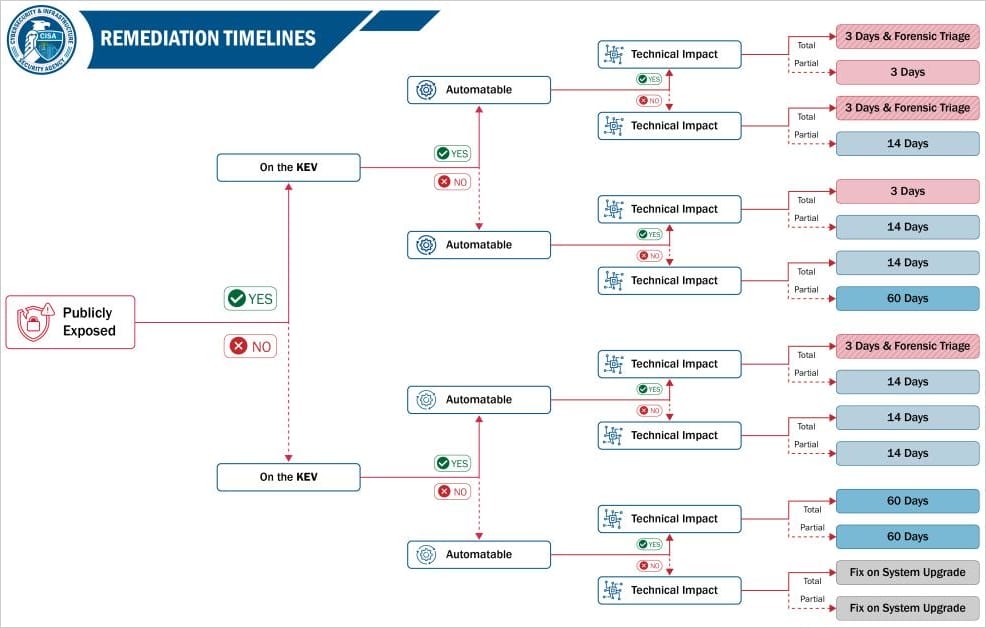 Vulnerability remediation timelines
Source: CISA
Scope and implementation
The directive applies specifically to U.S. Federal Civilian Executive Branch (FCEB) agencies and the information systems they operate.
This includes government agencies and departments, but does not apply to certain military systems operated by the U.S. Department of War, private companies, Intelligence Community systems, and contractors.
Like previous directives, the framework is expected to influence the broader cybersecurity industry and provide a broader patching priority signal.
The directive applies to all on-premise federal systems, third-party hosted systems, and FedRAMP/non-FedRAMP cloud environments.
Right now, agencies bound to the BOD 26-04 directive should update their vulnerability management policies accordingly, update their asset inventories, and automate KEV status reporting.
The vulnerability management processes should be updated in 60 days to use CVE and KEV data as the basis for remediation decisions.
Within 180 days, all agencies will be required to follow the new remediation timelines and continuously monitor and report detailed asset metadata.
Test every layer before attackers do
Security teams log 54% of successful attacks and alert on just 14%. The rest move through your environment unseen.
The Picus whitepaper shows how breach and attack simulation tests your SIEM and EDR rules so threats stop slipping by detection.
Related Articles:
GM agrees to $12.75M California settlement over sale of drivers’ data
CISA orders feds to patch exploited Ivanti EPMM flaw by Saturday
CISA flags new SD-WAN flaw as actively exploited in attacks
CISA gives feds three days to patch Ivanti flaw exploited as zero-day
CISA gives feds 3 days to patch actively exploited cPanel plugin flaw
Bill ToulasEmail bill.toulas@bleepingcomputer.comOpen Author's twitter page
Bill Toulas is a tech writer and infosec news reporter with over a decade of experience working on various online publications, covering open-source, Linux, malware, data breach incidents, and hacks.
Post a Comment Community Rules
You need to login in order to post a comment
Not a member yet? Register Now
You may also like:

Upcoming Webinar

Popular Stories
\ \ ServiceNow discloses security incident exposing customer data
Sponsor Posts
Upcoming Webinar
Login
Username
Password
Remember Me
Sign in anonymously
 Sign in with Twitter
Not a member yet? Register Now
Reporter
Help us understand the problem. What is going on with this comment?
- Spam
- Abusive or Harmful
- Inappropriate content
- Strong language
- Other
Read our posting guidelinese to learn what content is prohibited.
Submitting...
Read Original at BleepingComputer →