

Don't Miss
Advertisement
Voices
Here’s how Musk’s SpaceX IPO could crash your 401(k)

A contrail from a SpaceX rocket carrying Starlink satellites. It was launched from Vandenberg Space Force Base in California.
(Gregory Bull / Associated Press)

Business Columnist Follow
June 9, 2026 3 AM PT
-
5
-
9 min Click here to listen to this article
-
Share viaClose extra sharing options
0:000:00
1x
This is read by an automated voice. Please report any issues or inconsistencies here.
Wall Street is moving to stuff SpaceX shares into small investors’ portfolios, exposing them to a potentially overpriced stock.
Fidelity Investments, the big brokerage and mutual fund firm, long has had a rule protecting its small retail clients from plunging into initial public stock offerings while the shares were still subject to IPO-related hype.
In most cases, Fidelity would allow IPO investments only for clients with at least $500,000 in their brokerage accounts.
No longer. For the SpaceX IPO expected to launch on June 12, Fidelity has cut the threshold to only $2,000.
Advertisement
This estimate borders on fantasy.
— Aswath Damodaran, NYU, on SpaceX’s estimate of its market reach
It’s a curious decision, considering that the SpaceX IPO will be not only the largest such IPO in history — with a possible $75 billion in shares coming on the market, valuing the entire company at about $1.8 trillion — but potentially the most over-hyped. SpaceX, you may know, is the biggest company controlled by Elon Musk, so if you buy its shares, you’re buying into his vision.
A Fidelity representative told me that it made the change because SpaceX has reserved about 30% of its offered shares for retail investors, much more than the traditional 10%, “which means there are more shares being offered to retail clients.”
Advertisement
Commentary on economics and more from a Pulitzer Prize winner.
By continuing, you agree to our Terms of Service, which include arbitration and a class action waiver. You agree that we and our third-party vendors may collect and use your information, including through cookies, pixels and similar technologies, for the purposes set forth in our Privacy Policy such as personalizing your experience and ads.
Login or register with email
Agree & Continue
Fidelity’s liberalized policy is an example of how Wall Street has been moving the investment goalposts in order to stuff more of SpaceX’s shares into the portfolios of ordinary investors.
Fidelity’s clients, of course, can make their own decision about whether to buy in, but that’s not the case for owners of some stock index funds, who may find SpaceX among their holdings whether they like it or not.
That’s because managers of stock index funds are duty-bound to add a stock to their holdings once it’s added to the index they track.
Voices
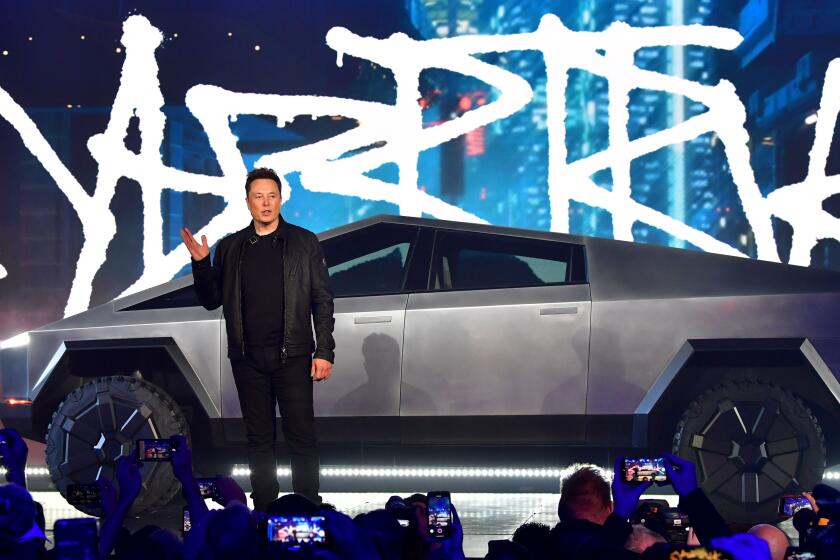
Hiltzik: How many Cybertrucks has Tesla sold to the public? Fewer than you might think
How bad are sales of Tesla’s Cybertrucks? Nearly 20% of the vehicles went to Elon Musk’s other companies, raising questions about the vehicle’s future.
May 5, 2026
The risk inherent in the SpaceX IPO may fall significantly on unwitting retirement account holders, who tend to be heavily invested in index funds. Vanguard, which pioneered index mutual funds, says that about 30% of retirement account holders choose equity funds if they’re offered by plan sponsors, and most are indexed.
There’s no mystery why Wall Street is anxious to sell SpaceX to the small investor. It’s because almost all of the major investment banks, led by Goldman Sachs, are underwriters of this massive stock issue, so they have an incentive to get the shares out the door promptly. Accordingly, there has been a big push on the Street to stuff them into the leading stock indices, leaving index fund managers no choice but to buy.
Before getting into some of the weirder features of the SpaceX IPO, here’s a brief primer into how index funds work and how index fund managers have responded to the prospect of a huge and widely followed stock issue dropping onto the market. Nor is SpaceX the only mega-IPO lurking on the horizon. It’s likely to be followed this year by the AI firms for Anthropic and OpenAI.
The overseers of stock indices, of which the largest are Standard & Poor’s (which owns the S&P 500, the standard benchmark for the overall stock market) and Nasdaq (owner of the Nasdaq 100 index of the largest Nasdaq-listed companies), generally have been cautious about when to add a stock to their indices.
Standard & Poor’s, for example, waits until a stock has been publicly traded for at least a year and has turned a profit in four quarters, including the quarter prior to its addition. At Nasdaq, the rule has been that companies have to wait for at least three months and have at least a 10% float, meaning that at least 10% of its shares are available for trading.
With the SpaceX IPO in the offing, however, Nasdaq reduced its “seasoning” period to only 15 days and removed the 10% threshold. I asked Nasdaq if it made the change to entice SpaceX to list on its exchange rather than on the New York Stock Exchange, but didn’t get an answer. Anyway, Nasdaq did get the listing.
Another index operator, FTSE Russell, which manages the broad-based Russell 2000 index, reduced its entry threshold for big companies to as few as five trading days after an IPO, rather than waiting for the next quarterly or annual report.
Investors may have dodged the most significant bullet on June 5, when Standard & Poor’s opted not to change its index-listing rules for any of its market indices. But if you’re holding index funds that track the big-cap Nasdaq 100 or the Russell 2000, you’ll be tethered to SpaceX , depending on its weight in the index — if it keeps flying, good for you. If it crashes, you’ll take a loss.

Voices
Hiltzik: Musk and other tech gurus say human-like robots are the next big thing. Don’t hold your breath
Investors are pouring billions into companies pitching humanoid robots, but functional versions are decades away.
Oct. 6, 2025
That brings us back to SpaceX itself. As its name indicates, the company is best known as a rocketship firm, with billions of dollars in U.S. government contracts aimed at transporting humans to the moon.
But what is it, really? In its prospectus, the company describes its mission as building “the systems and technologies necessary to make life multiplanetary, to understand the true nature of the universe, and to extend the light of consciousness to the stars.”
This is not the language of Benjamin Graham and David Dodd, the gurus of value investing. It’s more like the language of Robert A. Heinlein, who wrote science fiction. (As it happens, Heinlein coined the term “grok,” which Musk took as the name for the AI bot of his social media platform X.)
Even if you believe in the goals, none of them is rationally achievable within the traditional investor’s horizon of a few years or even a few decades, much less within your lifetime. The same goes for the company’s claim of a “total addressable market,” or TAM, of $28.5 trillion for its products and services; for perspective, consider that the gross domestic product of the United States in 2025 was about $32 trillion.
Almost all of SpaceX’s claimed TAM comes from its prospective AI business — the only one of its three business segments that has virtually no concrete achievements to claim. It’s not clear that even Heinlein would have written such a stretch into his books.
In real life, Aswath Damodaran, the stock valuation expert at NYU, says the figure “borders on fantasy” and places it in the same category as other “bloated and patently unreachable numbers floated for companies” by Silicon Valley promoters.
Currently, the jewel in SpaceX’s revenue crown is Starlink, Musk’s network of orbiting internet-providing satellites. Starlink provided the largest share of SpaceX’s revenue in 2025 — $11.32 billion of its $18.8 billion — and was its only profitable segment, with $4.42 billion in net income. Space operations lost $657 million on $4.08 billion in revenue, and AI lost $6.36 billion on $3.2 billion in revenue.
The IPO, therefore, looks like a massive bet on AI, propped up by profits from Starlink. There’s reason to be concerned about Starlink’s future, however. SpaceX’s IPO prospectus discloses that although the number of Starlink subscribers has more than doubled over the last year, to 10.3 million as of March 31 from 5 million a year ago, its average revenue per subscriber has been shrinking, to $66 as of March 31 from $99 at the end of 2023.

Voices
Hiltzik: That $1-trillion Tesla pay package for Elon Musk isn’t as bad as you think. It’s worse
Tesla says it set difficult targets for Musk to collect his $1-trillion pay. But the goals have been tweaked to make it easier.
Sept. 16, 2025
Moreover, Starlink satellites have a useful life of only five years, meaning that the fleet has to be refreshed more often than the average American household replaces the family car, at untold expense in research and development and launches. About 10,000 satellites are currently in orbit.
It’s also possible that Starlink may run into increased political backlash. Its satellites have been blamed for interfering with astronomical observations and posing an ever-increasing risk of space collisions.
In 2021, Musk dismissed the collision concerns: “Space is just extremely enormous,” he said, “and satellites are very tiny.”
Then there are the governance features of SpaceX. Put simply, only one person is in a position to make any decisions, Elon Musk. He will own a mere 12.3% of the Class A shares due to be issued in the IPO, which each receive one shareholder vote, but 93.6% of the Class B shares, which have 10 votes each. That gives him 85.1% of all shareholder votes. As a result, the prospectus says, “Mr. Musk will be able to control the outcome of matters requiring shareholder approval,” including the selection of the board of directors.
Will he exercise his control mostly for the benefit of shreholders, or for himself? His record isn’t encouraging. As I’ve reported, he has a habit of using his various companies to prop up each other, most recently by sticking SpaceX and other companies with the excess inventory of Cybertrucks, the ridiculed pickups marketed by Tesla, which he also controls. When his SolarCity solar energy company ran into financial trouble in 2016, he merged it into Tesla with the assent of a compliant Tesla board.
None of this necessarily means that SpaceX will be a drag on the market. It could soar on IPO days and remain aloft, despite what the numbers suggest will be a majestic overvaluation from the inception. Or not. Either way, small investors could end up holding the bag.
Latest from Michael Hiltzik
- Voices
Hiltzik: The Republican assault on Obamacare has created a healthcare bloodbath, with worse yet to come
- Voices
Hiltzik: U.S. World Cup hotel bookings are disappointing, and Trump is a major reason
- Voices
Hiltzik: Are dodos and mammoths coming back from extinction? Don’t count on it
More to Read
SpaceX IPO video sells Elon Musk’s space, AI and asteroid dreams to mom-and-pop investors
June 4, 2026

SpaceX seeks $75 billion in record IPO to fund AI, launch
June 4, 2026

SpaceX files to go public in huge IPO deal
May 20, 2026
Perspectives
The following AI-generated content is powered by Perplexity. The Los Angeles Times editorial staff does not create or edit the content.
Ideas expressed in the piece
-
The article argues that Fidelity’s decision to drop its IPO-participation threshold from $500,000 to $2,000 for the SpaceX offering shows how traditional guardrails meant to keep inexperienced investors out of hyped IPOs are being dismantled specifically to funnel this stock into the hands of small clients, exposing them to unusually high risk.
-
It further contends that Wall Street is systematically “moving the goalposts” for SpaceX by pushing index providers to accelerate inclusion, so that ordinary investors wind up owning the stock automatically through index funds and retirement accounts, even if they never explicitly chose to buy SpaceX shares.
-
In that same vein, the piece highlights recent rule changes by Nasdaq and FTSE Russell that sharply shorten or almost eliminate the normal “seasoning” period before adding new IPOs to major indices, describing these shifts as a way to force-feed an enormous, speculative stock into index portfolios much faster than in the past.
-
The column warns that because 401(k)s and other retirement accounts are heavily concentrated in index funds, millions of savers could see meaningful exposure to SpaceX whether they want it or not, and could suffer outsized losses if the stock proves to be significantly overvalued and then falls.
-
The article portrays SpaceX’s valuation and growth story as driven more by aspirational marketing than by fundamentals, emphasizing that its prospectus language about making life “multiplanetary” and its enormous, AI-heavy “total addressable market” estimate resemble science fiction more than sober financial analysis.
-
It underscores that the bulk of SpaceX’s current profits come from Starlink while its space and AI divisions lose billions, arguing that this makes the IPO essentially a high-risk AI bet subsidized by a single profit center whose average revenue per user is already declining and whose satellites must be replaced frequently at great cost.
-
The piece also raises concerns about non-financial risks, such as growing political backlash over Starlink’s impact on astronomy and space debris, suggesting that regulatory or diplomatic pushback could add further volatility to both the company and any index fund that is compelled to hold it.
-
Finally, the article stresses corporate-governance red flags: Musk’s super-voting control gives near-total power over SpaceX despite a relatively small economic stake, and the piece notes a pattern of related-party maneuvers at Musk’s other companies, implying that minority shareholders and retirement savers could be left “holding the bag” if decisions are made to serve Musk’s interests over theirs.
Different views on the topic
-
By contrast, coverage in financial and business outlets notes that, even if SpaceX is quickly added to major indices, its initial weight in broad index funds is likely to be small because of float-adjusted methodologies, so any short-term impact on a diversified 401(k) is expected to be modest rather than catastrophic.[1]
-
Some retirement experts cited in national business reporting argue that big, buzzy IPOs rarely cause dramatic, immediate swings in retirement balances, emphasizing that long-term savers are typically insulated by diversification across hundreds of holdings and decades-long time horizons.[1]
-
In response to fears that rule changes at index providers are designed mainly to “stuff” SpaceX into portfolios, other analyses point out that providers also face pressure to include very large, widely traded companies soon after listing so that their benchmarks remain representative of the actual market, especially when firms debut at valuations near or above $1 trillion.[2]
-
While acknowledging that Nasdaq and FTSE Russell have shortened seasoning periods, some commentary frames these moves as a broader structural shift to accommodate an emerging wave of mega-IPOs such as SpaceX and Anthropic, not as a SpaceX-only carve-out, and suggests that index committees are trying to balance investor protection with keeping indices relevant.[2]
-
Several advisors quoted in major business publications say most Americans either have no retirement savings or hold the bulk of their 401(k) assets in core funds linked to the S&P 500, which for now is not changing its rules; in this view, many retirees may see little or no direct exposure to SpaceX at the outset, despite the media attention.[1]
-
Additionally, some financial planners argue that for younger workers with many years until retirement, automatic exposure to a volatile, high-growth stock via a tiny slice of an index fund is neither a major threat nor a game-changing opportunity, but simply part of the normal ebb and flow of equity markets that long-term investors already accept.[1]
Show Comments
Commentary on economics and more from a Pulitzer Prize winner.
By continuing, you agree to our Terms of Service, which include arbitration and a class action waiver. You agree that we and our third-party vendors may collect and use your information, including through cookies, pixels and similar technologies, for the purposes set forth in our Privacy Policy such as personalizing your experience and ads.
Login or register with email
Agree & Continue
Follow Us
Pulitzer Prize-winning journalist Michael Hiltzik has written for the Los Angeles Times for more than 40 years. His business column appears in print every Sunday and Wednesday, and occasionally on other days. Hiltzik and colleague Chuck Philips shared the 1999 Pulitzer Prize for articles exposing corruption in the entertainment industry. Follow him on Bluesky at hiltzikm.bsky.social, on X at @hiltzikm and on Facebook at facebook.com/hiltzik.
More From the Los Angeles Times

Astronauts briefly take shelter during repair to fix leak on the International Space Station
June 5, 2026

Competition to run JPL comes at fraught moment of federal budget cuts, project overruns, management missteps
June 2, 2026

Blue Origin investigates rocket explosion as public is warned about possible wreckage washing ashore
May 29, 2026

Aerospace company behind Garden Grove chemical leak scare faces court cases, supply disruption
May 27, 2026
Most Read in Business

New evidence confirms Edison’s idle line ignited Eaton fire, lawyers say
June 9, 2026

This new law could create a million new apartments and condominiums in California
June 9, 2026

Value of Huntington Beach defense tech startup balloons to $1.8 billion
June 3, 2026

Apple revamps Siri as it tries to catch up in the AI race
June 8, 2026
Advertisement
Advertisement
Read Original at Los Angeles Times →