
Advertisement
From mice to ‘gym rats’: Unregulated use of peptides raises alarm among researchers
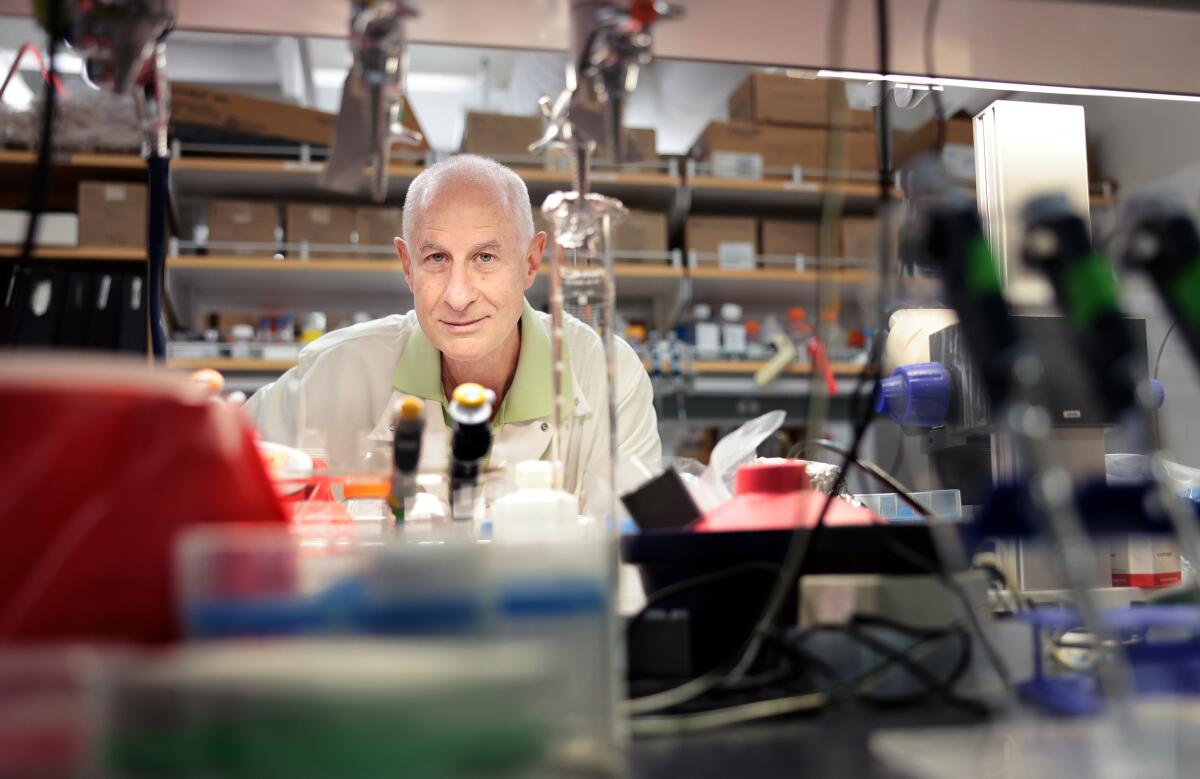
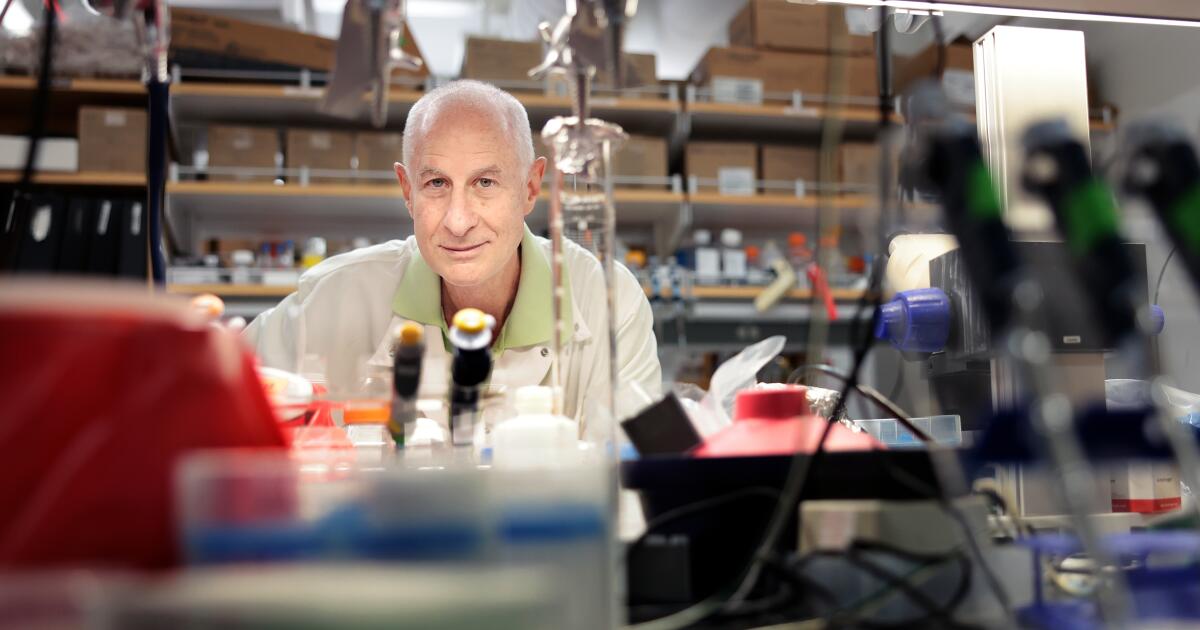
Pinchas Cohen, dean of the USC Leonard Davis School of Gerontology, pictured in a campus lab.
(Christina House / Los Angeles Times)

Staff Writer Follow
Aug. 6, 2026 3 AM PT
-
6
-
8 min Click here to listen to this article
-
Share viaClose extra sharing options
0:000:00
1x
This is read by an automated voice. Please report any issues or inconsistencies here.
See more from the L.A. Times in Google Search. Set us as preferred
A few months ago, Pinchas Cohen learned of a thriving online trade in MOTS-c — a peptide that, when injected into mice, seems to mimic the effects of exercise.
The dean of the USC Leonard Davis School of Gerontology was very familiar with this particular short chain of amino acids. His lab identified it years ago as one of the thousands of peptides that act as chemical messengers in the human body, one he believed might someday have therapeutic uses for humans.
But Cohen was alarmed to learn that his discovery was now being promoted by legions of longevity seekers, fitness enthusiasts and wellness influencers as “exercise in a bottle.” Though not approved by the U.S. Food and Drug Administration, it was widely available online, often in vials marked “for research use only.”
Advertisement
“Turns out that tens of thousands of people are injecting themselves with MOTS-c [that’s] black market, illegal, from unknown sources, unknown purity, unknown sterility, and I strongly object to that,” Cohen said.
Driven by social media hype and a growing distrust of public health guidance, consumer demand for experimental peptides has exploded over the last decade. Now, the clamor over unregulated peptides is fueling a high-stakes policy battle within the federal government. Health and Human Services Secretary Robert F. Kennedy Jr. has described himself as a “big fan” and user of peptides, and has pledged to end the government’s “aggressive suppression” of them.

Neurodivergent kids face special mental health risks. New initiative seeks ways to protect them
Jake Collective and the American Foundation for Suicide Prevention are launching a $5 million, five-year initiative
July 24, 2026
Some peptides, such as insulin, human growth hormone and glucagon-like peptide-1, have delivered transformational therapeutic effects when administered to humans.
Advertisement
But every vial of insulin or GLP-1 medication on a pharmacist’s shelf is the product of decades of clinical trials and safety testing. There are reams of data on what these drugs do, for whom they are most effective and in what dose and form they should be administered.
For MOTS-c and a raft of other peptides widely available online, no comparable evidence exists.
Although proponents say the substances help with weight loss, energy and muscle mass, and often cite research that has been done solely on animals or on a very small number of humans, no one knows for certain how or when it should be used in humans. While many users take multiple peptides together in custom combinations, or “stacks,” there is no data on how different synthetic peptides interact with one another.
To date, most of these popular peptides have been available solely in unregulated online marketplaces. But recently, an FDA committee voted to recommend that compounding pharmacies be allowed to manufacture six different peptides already widely available online: BPC-157, TB-500, KPV, epitalon, Semax and MOTS-c. A seventh, emideltide, was voted down.
Compounding pharmacies, which mix bespoke drugs, are a loophole in the U.S. regulatory system. While the drugs they produce aren’t FDA-approved, the pharmacies still have to follow their state’s safety and quality regulations.
Cohen traveled to Washington, D.C., to speak before the committee, many of whose members work for the kind of telehealth, longevity and wellness companies that stand to benefit financially from the peptides’ regulation.
Given that MOTS-c is already widely used off-label and no research has shown evidence of harmful side effects, Cohen said in his remarks that he believed “quality-controlled, prescriber-supervised” compounding was the safest way forward.
“We can’t stop the black market. So I think it’s a better choice to at least guarantee the quality, the sterility, and require that real doctors are part of the process,” he said later. “I really think this is a better choice than just letting it go on the way it is.”
Not everyone agrees with him. FDA staff who spoke at the two-day meeting advised against peptide compounding, saying there was not enough safety data to justify the move.

Trump administration proposal would all but end scientific merit in grant funding, critics say
Proposed in late May, the rule would give political appointees unprecedented control over federal grants for research, education and infrastructure.
July 10, 2026
The vote is non-binding, and the FDA could choose to side with its own scientists.
“My impression is that the ‘lesser of two evils’ argument is a minority perspective,” said Paul Knoepfler, a cell biology and human anatomy professor at the UC Davis School of Medicine who writes frequently on peptides.
“While it’s true that most compounders can likely [produce] purer versions of these peptides than what’s in the gray market, that doesn’t address potential inherent risks of the peptides themselves,” Knoepfler said. “There’s no special reason they should be allowed to bypass the standard clinical trial system just because there’s a peptide fad driven by wellness influencers and telehealth firms.”
Cohen found MOTS-c by combing through the 97% of human DNA that doesn’t encode for genes. This biological hoard once dismissed as “junk DNA” or the “dark genome” has turned out to be full of hormones and microproteins that play important roles in directing the body’s systems and processes.
Roughly 250 papers from dozens of research labs around the world have been published on MOTS-c since Cohen’s lab identified it. While the peptide’s risks and side effects are few, and its effects on mouse metabolism compelling, no one knows how long-term use affects humans yet, or what formula or dosage would be most effective. Influencers’ claims about the peptides’ effect on human weight loss, muscle mass, longevity and energy appear to be extrapolated from their effects on lab animals.
“Certain groups of people — for example, the fitness enthusiasts, which is the kind way to refer to gym rats — those people take one figure from one paper done on mice and take it to become gospel,” Cohen said.
Many users have been happy to essentially volunteer themselves for further testing.
“Today I used Mots-c for the first time and I’m a believer,” a Reddit user posted earlier this year. “I did some outdoor sports for about an hour and then came home and spent several hours doing every chore that had been piling up all week.”
The reality is more nuanced. For scientists like Cohen, these molecules are an exciting area of research that could reap significant health breakthroughs. But rigorous science takes time, and they’re up against a public that has lost patience with the traditional drug approval model — and a market that is happy to provide alternatives.

4 more states report cyclosporiasis outbreak. Here’s how the FDA does a traceback investigation
Experts explain how health officials investigate foodborne illnesses amid a second outbreak of cyclosporiasis.
July 24, 2026
In an ideal world, Cohen said, he would like to see MOTS-c developed into an FDA-approved drug. But in the actual world, taking a single drug from the lab to the market requires so much time (at least 10 years, usually more) and money (at least hundreds of millions of dollars, usually more) that very few candidates successfully reach that goal. His own efforts to move MOTS-c through the development pipeline stalled.
“Peptides are neither miracle cures nor snake oil. They are signaling molecules. Some have strong evidence. Some have intriguing or early data. Some are wildly overhyped, and some probably should never leave the laboratory,” said Dr. Ben Gonzalez, a former emergency medicine physician at Walter Reed Army Medical Center, at the FDA meeting. “Patients are looking for alternatives, and they are looking not at physicians. They’re looking at this gray market source.”
If compounded peptides are ultimately approved, Cohen would like to start an online registry where patients can anonymously record the dosage they’re taking, the reason they’re taking it and any side effects they experience, so that scientists can collect some data on this real-world experiment.
“The big picture is that we’re transitioning as a nation from the 20th century model [in which] all healthcare was dictated by physicians and insurance companies to a new 21st century model where consumers are demanding and receiving health and wellness services and products that they pay for in cash,” Cohen said. “I’m not saying that’s a better model. But it’s the model we’re transitioning into.”
More to Read

FDA panel narrowly backs unapproved peptide drug touted by Joe Rogan and other influencers
July 23, 2026

Voices
Contributor: Fuel drug development, not Big Pharma’s profits
May 12, 2026

FDA to weigh easing limits on unproven peptides favored by RFK Jr. and other MAHA figures
April 16, 2026
Show Comments
Science & Medicine California World & Nation
Follow Us
Corinne Purtill is a science and medicine reporter for the Los Angeles Times. Her writing on science and human behavior has appeared in the New Yorker, the New York Times, Time Magazine, the BBC and elsewhere. Before joining The Times, she worked as the senior London correspondent for GlobalPost (now PRI) and as a reporter and assignment editor at the Cambodia Daily in Phnom Penh. She is a native of Southern California and a graduate of Stanford University.
More From the Los Angeles Times

Senate confirms Dr. Erica Schwartz as CDC director, bringing new leadership to troubled agency
Aug. 5, 2026

Lineage says it will spend up to $100 million on Boyle Heights cleanup as air regulators demand action
Aug. 5, 2026

Discarded SpaceX rocket crashes into moon
Aug. 5, 2026

Tanning is getting hot again. Here’s what it really does to your skin
Aug. 4, 2026
Advertisement
Advertisement
Read Original at Los Angeles Times →