Skip to main content Skip to navigation
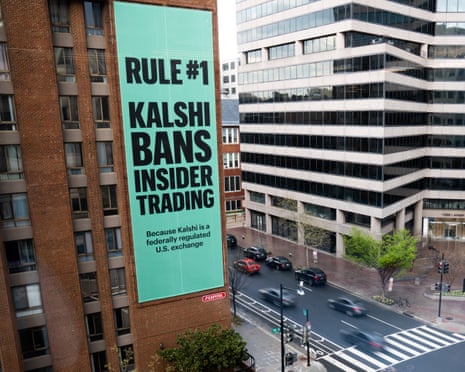
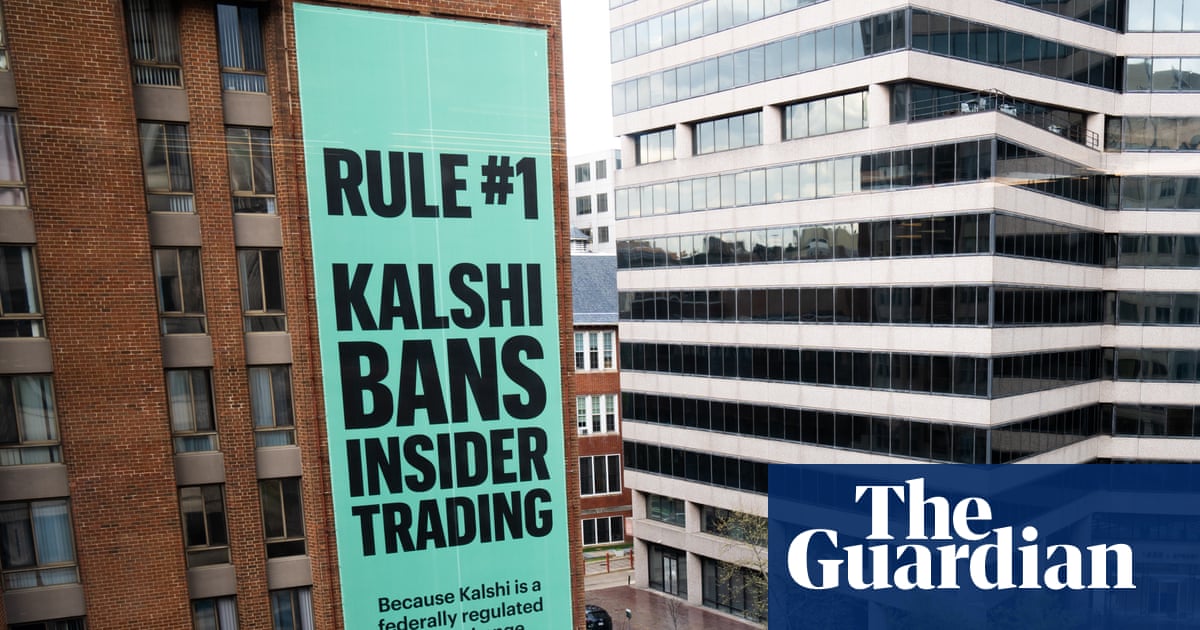
An advertisement for Kalshi in Washington DC on 1 April 2026. Photograph: Allison Robbert/AP
An advertisement for Kalshi in Washington DC on 1 April 2026. Photograph: Allison Robbert/AP
New York sues Kalshi prediction market alleging ‘illegal gambling operation’
Calling it an ‘illegal, unlicensed gambling operation’, state seeks to halt Kalshi’s operations and force it to forfeit profits
The state of New York has filed a lawsuit against Kalshi, accusing the prediction market operator of “running an illegal gambling operation”.
The lawsuit, filed on Friday, was announced by Kathy Hochul, the New York governor, and Letitia James, the state attorney general. It seeks to force the New York-based company to forfeit its profits, provide restitution to harmed consumers and pay fines equal to three times its profits.
“Kalshi has chosen to ignore New York’s gaming laws, which exist to protect consumers, prevent problematic gambling, deliver funding for critical public services, and ensure that every company plays by the same rules,” Hochul said, adding: “This choice has consequences … no company is above the law.”
James, who in April filed a similar lawsuit against Coinbase and Gemini, echoed those remarks, saying: “New York’s gambling laws protect children from underage betting and help combat gambling addiction. No matter what they call themselves, prediction markets like Kalshi are gambling platforms, plain and simple. By ignoring our laws, Kalshi is running an illegal operation and harming New Yorkers in the process. We are taking them to court to uphold our laws and protect New Yorkers.”
The lawsuit claims that Kalshi’s prediction markets are a form of gambling because users bet on uncertain events they cannot control. It also alleges that Kalshi operates without a license from the New York state gaming commission, allowing it to avoid taxes that licensed casinos and sports betting platforms are required to pay. Revenue from regulated gambling helps fund public schools, youth sports programs and problem gambling prevention and treatment.
The lawsuit also alleges that Kalshi allows 18- to 20-year-olds to use its prediction markets, even though New York law requires users to be at least 21 to place mobile sports bets.
Responding to the lawsuit, the Kalshi spokesperson Elisabeth Diana said: “It’s sad to see this type of political theater from the leadership in our own state. States can’t just shut down a federally licensed exchange. This would also hurt New Yorkers, who would be driven offshore. We love New York, we love New Yorkers, and New Yorkers love our product.”
Prediction market platforms say they operate differently than gambling operations because consumers are trading against other consumers – much like how stock markets work. Prices are based on trading, and the platforms only take a fee from the trading, they say.
The platforms also argue federal law gives the US Commodity Futures Trading Commission (CFTC) exclusive jurisdiction to regulate transactions offered in the prediction market. In February, Trump’s appointee atop the federal commission declared that the agency “will no longer sit idly by” while states aim to regulate or ban prediction markets and “undermine the agency’s exclusive jurisdiction”.
States counter that the vast majority of the business on prediction market platforms is sports betting, which they are empowered to regulate, and that is completely different from the commodities and futures contracts that the commission regulates.
On Monday, a federal judge temporarily blocked Minnesota’s first-in-the-nation law banning prediction markets just days before it was to take effect – dealing a setback for states trying to outlaw or regulate the platforms.
In April, Arizona’s attorney general filed criminal charges against Kalshi, alleging that the company is illegally allowing users to bet on elections.
“Kalshi may brand itself as a ’prediction market’, but what it’s actually doing is running an illegal gambling operation and taking bets on Arizona elections, both of which violate Arizona law,” Arizona’s attorney general, Kris Mayes, said at the time.
In response, Kalshi called Arizona’s case “paper-thin”, arguing that it should not be “overseen by a patchwork of inconsistent state laws”.
skip past newsletter promotion
after newsletter promotion
Kalshi to offer betting on drug trial results and FDA regulatory decisions\ \ Read more
More than 20 federal lawsuits have been filed across the US over whether prediction market operators including Kalshi should be federally regulated as financial exchanges or as gambling businesses subject to state gambling laws. In April, the federal government sued Arizona, Connecticut and Illinois over their attempts to regulate prediction markets.
Unlike traditional sportsbooks, which can only operate in states where sports betting is legal, companies such as Kalshi are regulated at the federal level. They classify their products as “event derivatives” under commodities law, with users trading against one another rather than against a traditional “house”. As a result, they are overseen by the CFTC and can offer their services nationwide to users aged 18 and older.
Yet despite prediction markets not being regulated as gambling platforms, experts warn that they are just as addictive.
Speaking to the Guardian in May, Lia Nower, the director of Rutgers University’s center for gambling studies, said: “The more people gamble, the more activities they gamble on, and the more ways they gamble, the more likely they are to develop a problem.
“So, on average, unregulated markets like Kalshi and Polymarket will have an additive effect to the legal forms of gambling. This will likely contribute to increasing rates of problem gambling in the years to come,” Nower added.
The Associated Press contributed reporting
Explore more on these topics