
Site SearchClear
SEARCH
Search Results
Symbols
No results found
- All News
- Articles
- Video
- Podcasts
0 Results
No Results Found
Authors
No results found
Sections
No results found
Columns
No results found
Earnings Results
Nike earnings crushed Wall Street’s estimates — but here’s the catch
Stock heads for a 12-year low as Nike says demand slowed over the spring, and still expects falling sales in the months ahead
By
Updated July 1, 2026, 7:20 a.m. ET
Share
Add us on Google
Choose MarketWatch as a preferred source of financial news
Resize
(6 min)
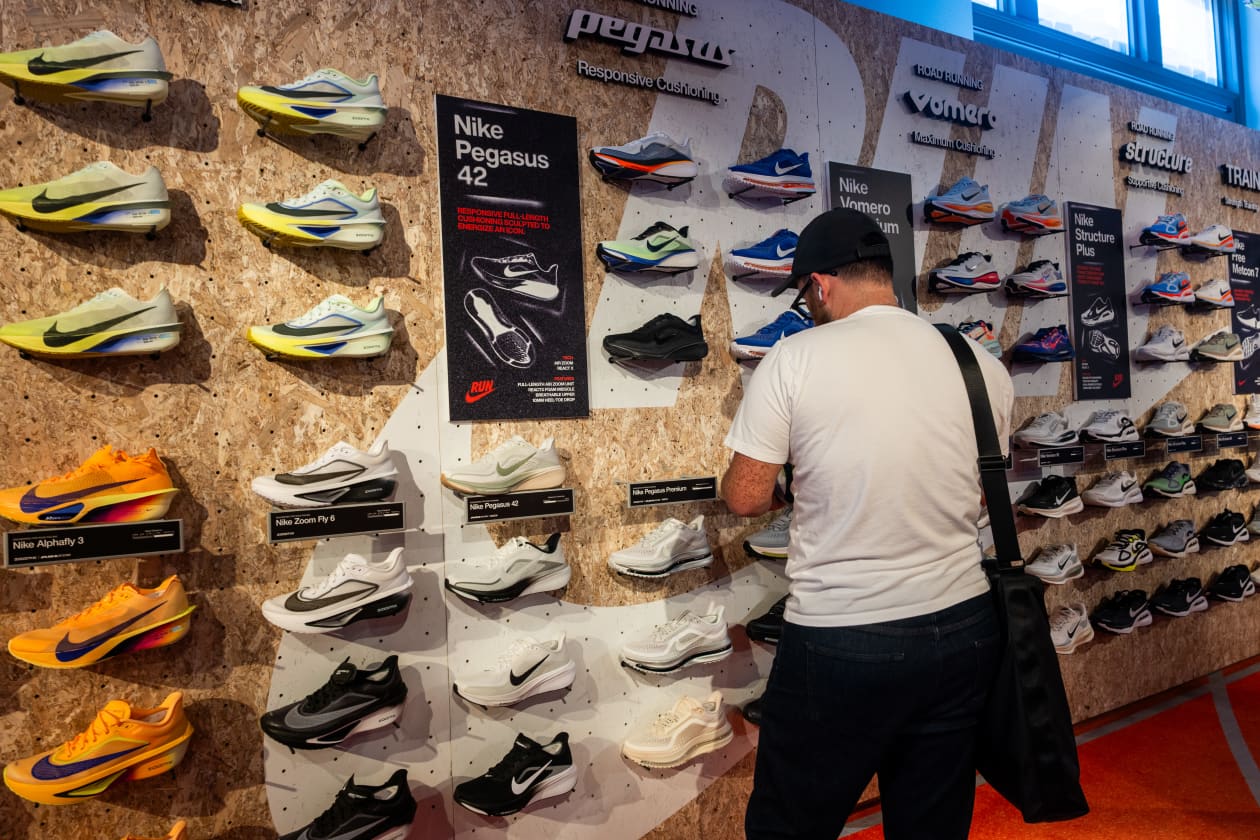
During Nike’s fourth-quarter earnings call on Tuesday, CEO Elliott Hill likened the sneaker giant’s prolonged turnaround efforts to the New York Knicks, who spent years getting the right team together and overcame numerous setbacks before winning its first NBA championship in more than 50 years this month.
But after Nike’s
forecast for the year, along with fourth-quarter earnings that beat estimates but relied heavily on a tariff refund, investors didn’t exactly feel the same way.
Shares fell 3% in premarket trading on Wednesday, to put them on track to open at the lowest prices seen since September 2014. Wall Street was weighing a sharper demand slowdown against a possible gross-margin rebound, as the company tries to recalibrate its business to win over cautious consumers.
Executives said they saw demand decelerate in April, particularly in Nike’s sportswear and Jordan streetwear segments, as shoppers put off discretionary purchases amid concerns about the Iran war and higher costs overall. Meanwhile, management said it was carrying out a “comprehensive reset” in China, where sales have fallen sharply.
“Overall, the results aren’t there yet,” Hill said during Tuesday’s call.
He added: “We’re operating in a more complex macro environment, where we’re seeing added pressure on traffic and discretionary spending across our geographies.”
Nike said it expects revenue to be down “low- to mid-single-digits” though most of this year. That’s a bit more pessimistic than expectations in March for a decline in low-single-digit percentage range. However, management said it expects higher gross margins, as it takes steps to tighten up purchases and more strictly manage inventories.
The company said that for the fiscal year ahead, which runs through next May, growth would expand beyond running shoes — a stronghold for Nike over recent months — into areas like basketball and training gear. Efforts to overhaul or close stores will continue. But they said they expect continued struggles for sportswear and Jordan streetwear, which make up around half of sales.
Nike’s stock has fallen more than 35% so far this year, as Wall Street grows more worried about the progress of turnaround efforts under Hill. Nike’s stock closed regular trading Tuesday at around $41, a roughly 12-year low.
Nike has struggled with weaker demand from cautious consumers and tougher competition from other sneaker brands. In March, management said it expected sales to fall this year and acknowledged that efforts to reignite demand had taken longer than expected.
At that time, management said business had gotten better in North America, helped by gains in soccer and running shoes. But some analysts have said Nike’s newer products — part of its efforts to focus on the needs of athletes — haven’t caught on with consumers. Nike’s digital business has faltered, and it has tried to refashion that segment into a destination for higher-priced fare, rather than discounting.
Nike’s quarterly results on Tuesday topped Wall Street’s estimates. But the profit beat came in large part due to tariff refunds.
Nike reported fiscal fourth-quarter revenue of $10.97 billion. That was down 1% year over year but better than analysts’ estimates for $10.85 billion.
However, tariff refunds helped profits and margins. Nike earned 72 cents a share during the quarter, well above Wall Street’s estimates for 12 cents.
The sneaker giant said Tuesday’s quarterly earnings-per-share figure included a 52-cent “benefit” tied to the expected recovery of President Donald Trump’s emergency-powers tariffs, which the Supreme Court struck down earlier this year. That expected tariff refund also boosted Nike’s gross margins.
Nike last week said its results would get a lift from tariff refunds that were “not contemplated in the company’s previously provided guidance.”
Nike’s sales to retailers rose 4% for the fourth quarter, which ran through May. Sales at the company’ own physical and online stores fell 7%.
In North America, sales rose 3%. But in China, they fell 12%. Management has said that it has underinvested in its stores in China and gotten trapped in a discounting war there, and that it needed to do more to connect with consumers locally. As with the U.S., where Nike is selling off unwanted Air Jordans and Air Force 1s, the company is trying to clean out its shoe surplus in China.
“The reported fourth quarter indicated some stabilization in the business, but continued unanswered questions about the arc of the company’s recovery,” Sarah Henry, portfolio manager at Logan Capital Management, said over email.
“The quarter prior revealed some success in righting the ship in the U.S., but significantly worse performance in China, which is becoming a much smaller part of the business,” she added.
Nike’s results also arrived as Wall Street tries to gauge the impact of the World Cup on demand for athletic gear. Research from LSEG last week showed that since the World Cup started, 28% of Nike’s merchandise related the tournament had sold out. That was better than 7% for rival Adidas
. On Tuesday, Nike executives said the World Cup was helping to attract consumers to the brand overall.
Meanwhile, David Denton is set to become Nike’s chief financial officer on Aug. 17, according to an announcement from last week. Matthew Friend, the current CFO, will leave that role but stay with the company through Sept. 4 to help with the transition.
Raymond James analyst Rick Patel said in a note last week that the appointment of Denton, who has been serving as the CFO of Pfizer
and was the CFO of Lowe’s
before that, was a mixed development.
“Positively, incoming CFO David Denton has managed large and complex companies that were striving towards their own operational improvement (Pfizer and Lowe’s),” he said. “But it also raises questions about how [Nike’s] current turnaround is tracking into this fall’s pivotal Investor Day.”
Copyright ©2026 MarketWatch, Inc. All Rights Reserved. 87990cbe856818d5eddac44c7b1cdeb8

Is the U.S. jobs market getting better? June employment report to give us a heat check.
Sandisk’s and Micron’s stocks sink as the rotation trade builds, but supply shortages should limit losses

‘I don’t think I’ll make it to 80’: I’m 70 and single. Do I take out a reverse mortgage or a home-equity agreement?

I tried to cut my taxes like a billionaire

Here’s what’s worth streaming in July 2026 on Netflix, Hulu, HBO Max and more
About the Author
Bill Peters is a Los Angeles–based MarketWatch reporter.
Show Conversation (8)
What to Read Next
products.gobankingrates.com
products.gobankingrates.com is blocked
This page has been blocked by an extension
- Try disabling your extensions.
ERR_BLOCKED_BY_CLIENT
Reload
This page has been blocked by an extension