

Advertisement
‘Pervert glasses’: Backlash against Meta’s smart glasses grows
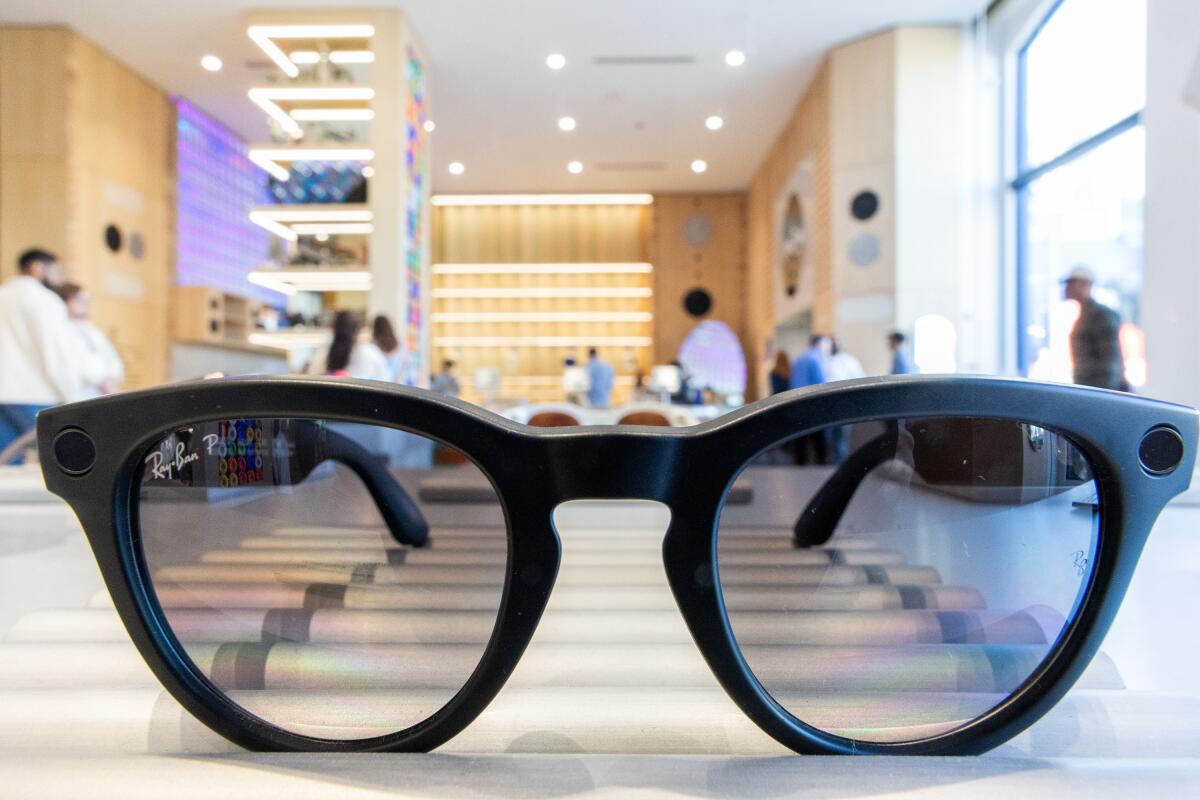
At Meta Lab in West Hollywood, visitors can try on the company’s wearables.
(Myung J. Chun / Los Angeles Times)

By Queenie Wong
Staff Writer Follow
Aug. 7, 2026 3 AM PT
-
49
-
8 min Click here to listen to this article
-
Share viaClose extra sharing options
0:000:00
1x
This is read by an automated voice. Please report any issues or inconsistencies here.
See more from the L.A. Times in Google Search. Set us as preferred
Meta wants its smart glasses to be a big hit, but the high-tech specs have also turned into a liability, as some are calling the gadget “pervert glasses.”
The social media giant dominates the market for smart glasses, which allow people to capture photos and videos, listen to music, take phone calls and ask questions to an artificial intelligence assistant.
Some people are using the glasses — which look like a pair of regular spectacles — to record people without their knowledge and publish the videos on social media.
Advertisement
The users secretly videotape and share what happens when they try to pick up women. Now, a growing number of people are worried they could be covertly recorded at the gym or even during sex.
The backlash has prompted Meta to update its glasses to address privacy concerns, and some places have banned them, adding to the angst surrounding technology that’s rapidly evolving. It’s too early to tell whether the criticism will dent sales of smart glasses, said Jitesh Ubrani, a director at the market research company IDC.
“A headline cycle like this is exactly the kind of thing that could slow momentum with mainstream buyers, even if early adopters don’t blink,” he said.
Advertisement
Artificial intelligence seems to be popping up everywhere, fueling the advancement of hardware beyond the smartphone but also debate about its use.
“We’re at a very sensitive time for the tech industry in terms of trying to really preserve that positive consumer sentiment that’s taking a bit of a hit due to AI, and it’s absolutely applicable to smart glasses,” said Jacob Bourne, a technology analyst at eMarketer.
Gaby Luisa was standing outside a dance club in Arizona earlier this summer when a man wearing glasses threw out a pickup line.
“Did I just run into my future wife?” he asked.
She politely let him know she wasn’t interested and moved on with her evening.
She was shocked to find out later that their interaction was recorded and posted on YouTube without her knowledge or permission, using smart glasses which, she said, looked like Meta’s glasses.
“It’s really weird to monetize off of people, and they’re not even aware that they’re being recorded,” she said in an interview.
Meta sells smart glasses online and at major retailers like LensCrafters and Best Buy. Prices range from roughly $224 to $800 depending on the version. The company has been opening new “Meta Lab” stores in Los Angeles and other cities, and has has teamed up with Ray-Ban, Oakley and well-known celebrities such as Kylie Jenner and Jennie from the popular K-pop group Blackpink to sell them.
Advertisement
Meta made up approximately 69% of the smart glasses market in the first quarter of this year, according to IDC. That quarter, the global market value of certain types of smart glasses more than tripled from a year earlier.
While Meta’s glasses have a flashing white light on their frames to notify people they’re being recorded, some users have been hiding or disabling the light by hiring people to drill into their eyewear so they can record in stealth mode.
Concern about the glasses has exploded as more videos of interactions with people who don’t know they’re being recorded go viral on social media.
On Instagram, some videos depict people getting approached in malls and grocery stores and on college campuses and sidewalks. While the videos are portrayed as jokes, the people filmed don’t appear to know they’re being recorded and sometimes seem uncomfortable, telling the strangers to leave them alone or stop harassing them.
The outcry has spread beyond social media, with comedian Jimmy Kimmel calling the Meta devices “pervert glasses” on national television and singer Lorde telling concertgoers that smart glasses are “not sexy.”
A spokesperson for Meta said people use its AI glasses because they’re “genuinely helpful” for tasks such as listening to music, live translation or hands-free calls. Meta last month updated its smart glasses so cameras get disabled if they’ve been tampered with. Meta plans to strengthen these protections as the glasses become more capable.
Advertisement
“The people who use them and those around them need to trust them. That’s why we built privacy into our AI glasses from the ground up,” the spokesperson said in a statement.

Meta Chief Executive Mark Zuckerberg wears artificial intelligence-powered smart glasses and a wristband as he speaks during the company’s 2025 Connect developer conference.
(Nic Coury / Associated Press)
Instagram, which is owned by Meta, has been disabling accounts and taking down some of these pickup or prank videos for violating the platform’s rules against harassment and bullying.
With tech giants such as Apple, Google, Samsung and Snap working on or planning to release high-tech eyewear, analysts say consumer adoption could grow. But they, too, will have to navigate privacy concerns surrounding smart glasses.
In April, the American Civil Liberties Union and more than 70 organizations sent a letter to Meta urging the company to commit to not releasing any facial recognition features in smart glasses and elsewhere, noting it poses a “serious threat to privacy and civil liberties.”
A spokesperson said “no final decision has been made” and that Meta will approach the rollout of any new feature thoughtfully and transparently.
Advertisement
Smart glasses have faced public backlash before.
More than a decade ago, early adopters of Google Glass encountered criticism if they used the $1,500 pair of smart glasses in socially unacceptable ways, such as secretly recording people and staring off into space while they browsed websites. Their nickname: Glassholes. Snap, which unveiled more powerful $2,195 augmented reality glasses this year, sold glasses that record video in bright yellow vending machines in 2016, but the product flopped.
The revolt brewing against smart glasses has made some users more wary about where they’re wearing the gadget and potential awkward encounters.

Race to make smart glasses relevant heats up again with new tech from Meta and Snap
Tech giants are trying to change the way we interact with computers. Meta showed off its latest lineup of smartglasses this week but competition with its rivals is expected to heat up.
Sept. 18, 2025
Ben Cook, a New York creator who posts about watches on TikTok, uses his Meta smart glasses to listen to music on runs and take hands-free calls. Family and friends, though, have asked if his “spy glasses” are recording.
“I don’t wear them to social events because I don’t really want to get into that conversation,” he said. “I’m not using it to record anybody.”
Google Glass sees all -- and that raises privacy concerns
Google Glass could be the next must-have gadget if the company can allay privacy fears and overcome its label as a ‘Segway for your face.’
Aug. 9, 2013
During a high-profile social media addiction trial in February at the Los Angeles County Superior Court, Judge Carolyn B. Kuhl warned people in the courtroom to take off any smart glasses, raising concerns that the jury could be identified. Use of recording devices, including phones, isn’t generally allowed in courtrooms.
Last year, the University of San Francisco issued a safety advisory about a man wearing Meta Ray-Ban sunglasses who was approaching women with “unwanted comments and inappropriate dating questions.” The man might have been trying to post pickup videos on social media platforms, the notice said.
Advertisement
Businesses are making their own calls about smart glasses. The 5 Point Cafe in Seattle, which banned Google Glass in the past, has banned Meta glasses from its diner and dive bar.
“Leave your Meta-SpyBan Display at home, they are officially Ray-Ban-ned from all of our restaurants. We serve privacy, not side-eye surveillance,” a 2025 Instagram post from the business states. The restaurant also doesn’t allow people to talk on their phones inside.
Meanwhile, people are finding new ways to figure out whether others nearby are wearing smart glasses.
Yves Jeanrenaud created an app to alert people if smart glasses could be nearby after learning about people being recorded without their knowledge. Released in February, the app has roughly 110,000 downloads on Android, with most of the users in the United States and Canada, he said. Users who have downloaded his app include a strip club owner, a Buddhist monk and parents.
“It’s a social problem that we encounter,” Jeanrenaud said. “That we don’t value privacy, that we feel entitled to use others for our entertainment or our private gain, and technology amplifies that.”
Jeanrenaud, who lives in Germany, has used his app, Nearby Glasses, and received an alert about smart glasses on a train, though he couldn’t figure out who was wearing them.
More to Read

Snap bets its future on AR glasses in crowded AI race
Aug. 4, 2026

China-linked AI ‘nudify’ ads flooded Facebook and Instagram, watchdog says
July 27, 2026
Samsung unveils privacy-first smart glasses to counter backlash against Meta glasses
July 23, 2026
Show Comments
Business Technology and the Internet World & Nation Artificial Intelligence
The Wide Shot brings you news, analysis and insights on everything from streaming wars to production — and what it all means for the future.
By continuing, you agree to our Terms of Service, which include arbitration and a class action waiver. You agree that we and our third-party vendors may collect and use your information, including through cookies, pixels and similar technologies, for the purposes set forth in our Privacy Policy such as personalizing your experience and ads.
Login or register with email
Agree & Continue
Follow Us
Queenie Wong is a technology reporter for the Los Angeles Times. At CNET and the Mercury News, she wrote about the world’s largest social networks. Wong also covered politics and education for the Statesman Journal in Salem, Ore. Growing up in Southern California, she started reading The Times as a kid and took her first journalism class in middle school. She graduated from Washington and Lee University, where she studied journalism and studio art.
More From the Los Angeles Times

Meta says its AI model hacked another company, adding to worries about bots going rogue
Aug. 7, 2026

OpenAI’s doughnut-shaped AI speaker could be your next smartphone replacement
Aug. 7, 2026

AI power surge is frying its own data centers and rattling the grid
Aug. 6, 2026

China’s AI blitz puts OpenAI and Anthropic in a ‘death zone’ on price
Aug. 5, 2026
Most Read in Business

Beautiful downtown Burbank isn’t a punchline. The city is booming while downtown L.A. struggles
Aug. 7, 2026

Insurance commissioner candidates split key endorsements
Aug. 7, 2026

California’s instant EV rebates are now available for these three brands

Major international ad agency moves to El Segundo
Aug. 5, 2026
Advertisement
Advertisement
Read Original at Los Angeles Times →