
Skip to main content Skip to navigation
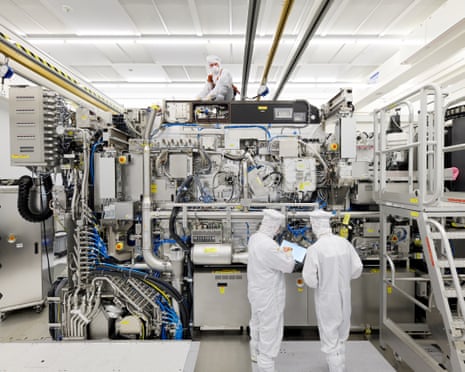
A lithography machine at ASML in Veldhoven, the Netherlands. The Chinese have broken the Dutch company’s hold over deep-ultraviolet lithography, a technique essential to the computer chip supply chain. Photograph: Bart van Overbeeke Fotografie/AS/Reuters
A lithography machine at ASML in Veldhoven, the Netherlands. The Chinese have broken the Dutch company’s hold over deep-ultraviolet lithography, a technique essential to the computer chip supply chain. Photograph: Bart van Overbeeke Fotografie/AS/Reuters
Stock market turmoil sheds stark light on the opaque AI economy
Aisha Down, Dan Milmo and Graeme Wearden
Investors scramble to make sense of a shock Chinese challenge to the dominance of western chipmakers
Even for the rollercoaster world of AI, last week was particularly volatile as investors scrambled to keep up with developments that threatened the dominance of the largest western chipmakers.
It began with a double whammy. On Monday, the Chinese memory chipmaker CXMT floated on the Shanghai stock market, soaring by 466% in value to 3.3tn yuan (£365bn).
That same day, it was reported that China had developed its own tools to carry out deep-ultraviolet lithography, a technique essential to the computer chip supply chain over which the Dutch company ASML had held a monopoly.
AI-linked shares, particularly chipmakers, dropped around the world, sending many indices sliding. South Korea’s main share index, the Kospi, fell 11.5% on Tuesday and a further 6% on Wednesday, dragged down by its two biggest companies – the semiconductor maker SK Hynix and Samsung Electronics.
On Thursday, the main US tech index, the Nasdaq, fell into correction territory at one point after dropping more than 10% from its recent high, before easing back. Nvidia lost more than 5% by Thursday evening, by which time it had been overtaken by Apple as the world’s largest listed company.
The next day there was a big rebound, when strong financial results from Amazon and Microsoft calmed traders’ nerves. The Kospi jumped nearly 20% – although the week’s slump still means it recorded its worst month since the height of the global financial crisis in October 2008.
So, what exactly do these advances mean, and why have they got western investors so jittery?
CXMT’s debut is impressive. But the company is arguably more of a boon to the global AI economy than a threat. It makes dynamic random-access memory (Dram) chips, which store the data that other AI chips draw on for their calculations.
There is a global shortage of Dram chips, which is why phones and computers are expected to get far more expensive. Crucially, they are not graphics processing units (GPUs) – which are the key chips and the “brains” in an AI system.
This means, put simply, that CXMT is not a threat to GPU maker Nvidia, the biggest company in the AI economy and the only one making a profit on AI. They produce complementary, not competing goods.
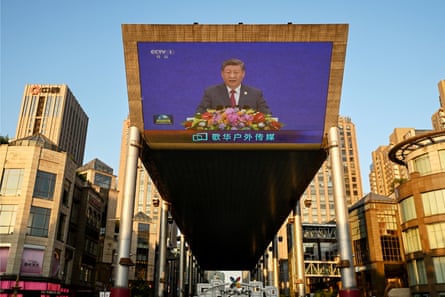
China’s president, Xi Jinping, speaks at the opening of the World Artificial Intelligence Conference in Beijing. China is making rapid advances in the semiconductors used to drive AI. Photograph: Greg Baker/AFP/Getty Images
The Chinese company could be a threat to SK Hynix and Micron, which do make memory chips. However, Alvin Nguyen, an analyst at the research firm Forrester, said the sell-off in these shares was an “overreaction” given that the global memory chip shortage is likely to continue until 2030.
“SK Hynix, Micron, others, they can’t produce enough memory chips to begin with … the demand keeps growing even higher,” Nguyen said.
A more serious concern could be the news that China can make the lithography tools. These are essentially extremely precise lasers that allow chipmakers to etch the thinnest lines in the world into wafers of silicon.
Until now, only ASML could manufacture such machines. If this week’s reports are correct, Beijing could – in theory – produce GPUs that rival Nvidia’s. This would spell trouble for the world’s biggest company, and therefore Wall Street. But a serious competitor is still years away.
“Fabs [semiconductor fabrication plants], as I know them, still take years to develop,” said Nguyen.
Mark Boost, the chief executive of the UK cloud company Civo, agreed. “Investors are overreacting to the short-term threat,” he said. “Manufacturing a handful of [deep-ultraviolet] machines is a massive symbolic victory, but not a commercial replacement for ASML overnight.
skip past newsletter promotion
after newsletter promotion
“Fabs run on efficiency and yield, and until these Chinese tools can match western reliability, ASML’s global dominance remains structurally safe outside mainland China.”
Long term, this week’s advances are gamechanging for the AI economy, although in many ways they should have been predictable. Given US export controls, China has had little choice but to develop domestic capabilities.
Chris Beauchamp, the chief market analyst at IG, an online share trading company, said: “These Chinese chip companies appear poised to do to the big chipmakers what they have done to steel, automobiles and a host of other industries, namely undercut them and outcompete them on price.”
It may be that last week’s correction is an overreaction – but also a reasonable response to a circular and extremely opaque AI economy that rests heavily on the fate of a single company, Nvidia.
Its shares are gradually creeping up again, although they are still below what they were last week. A contributing factor to the investor skittishness appears to be yet another circular, opaque deal.
Last Sunday, the Wall Street Journal reported that Nvidia was considering providing a $250bn (£186bn) backstop to OpenAI for a large datacentre project. This comes roughly half a year after a $100bn deal between the two companies fell apart.
It was a significant factor in Nvidia’s decline over the week, according to Morningstar. The anxiety that underlies this is that the company has become the “ central bank of AI” – holding up vast parts of the economy, and the global stock market, in ways that most people, investors included, do not understand.
Many believe that it cannot last. What is on the other side is less clear.
“Nvidia knows the gravy train’s going to run out,” Nguyen said. “Everybody’s waiting for them to fall apart. I don’t know that they will because what they do still has value … at some point in the future, they’ll no longer be one of the most valuable companies in the world. Maybe … they’ll be worth only $2tn. It’s still pretty good.”
At this dangerous time
We hope you appreciated this article. Before you close this tab, we want to ask if you could support the Guardian at this dangerous time for journalism in the US. For the next several days only, we are offering 50% off our most impactful monthly support option.
According to a leading global watchdog, American democracy is now more imperiled than at any point since the 1960s, marked by a precipitous decline in press freedom – driven by mounting pressure from the Trump administration in the form of threats, criminal investigations, politicized regulation, frivolous lawsuits and, for public media, catastrophic funding cuts.
Meanwhile, organizations that are supposed to be independent like the FBI and the FCC, our radio and television regulator, have also been targeting press freedom under Trump-aligned leadership, with the FBI raiding a reporter’s home and the FCC threatening ABC’s TV licenses after Jimmy Kimmel made a joke about Melania Trump.
The response from some ultra-wealthy and corporate media owners, keen to appease the president, has been chilling: CBS News has been taken over by a Trump ally; CNN may be taken over by the same billionaire; Jeff Bezos has continued to impose cuts and editorial interventions at the Washington Post; and multiple outlets have settled multimillion-dollar lawsuits from the administration to protect their business interests.
Democracy is best served by a robust, thriving free press. But when that freedom is under attack, it falls to a determined few news organizations to ensure the full truth still reaches the public. Owned neither by a billionaire nor a corporation, the Guardian remains dedicated to covering this administration with uncompromising moral and factual clarity – and to keeping trustworthy journalism paywall-free for the world.
Despite the risks of maintaining our fierce independence, what sustains us – and fills us with deep gratitude – is the unwavering support we’ve seen from readers. It is no exaggeration to say that we are here because of you: a majority of our funding comes directly from people like you responding to messages like this. Your support not only powers our work, but more importantly, it safeguards the financial independence that underpins our editorial freedom and courage.
We know our requests for support are not as welcome as our reporting, but without them, it’s simple: our reporting wouldn’t exist. Of course, we understand that some readers are not in a position to support us, and if that is you, we value your readership no less.
But if you are able, please support us today. All gifts are gratefully received, but for the next several days only, we are offering a 50% discount for six months off our most impactful monthly support option. (Among the great benefits you get in return: you’ll see far fewer annoying fundraising messages like this.) It takes just 37 seconds to set up. Thank you for considering.
Support once from just $1
We welcome support of any size, any time - whether you choose to give $1 or more
50% off
Support $15 $7.50/monthly
Unlock All-access digital benefits:
- Far fewer asks for support
- Ad-free reading on all your devices
- Unlimited access to the premium Guardian app
- Regular dispatches from the newsroom to see the impact of your support
- Unlimited access to Feast, the Guardian recipe app
Support another way
Remind me in September

Explore more on these topics
Share
Most viewed
-
 \
\
RFK Jr tells US families to vaccinate children against measles amid outbreak
\
\
RFK Jr tells US families to vaccinate children against measles amid outbreak -
 \
\
‘Stop all outdoor activities’: South Korea records its highest ever temperature
\
\
‘Stop all outdoor activities’: South Korea records its highest ever temperature -
 \
\
At least five Mohamed Al Fayed abuse survivors confirmed as human-trafficking victims
\
\
At least five Mohamed Al Fayed abuse survivors confirmed as human-trafficking victims -
 \
\
‘The greatest arms I’ve ever seen’: Matt Damon’s muscular female stunt double Devyn Dalton
\
\
‘The greatest arms I’ve ever seen’: Matt Damon’s muscular female stunt double Devyn Dalton -
 \
\
Ariana Grande to take ‘a step back’ from public life due to ‘endless, ongoing scrutiny’
\
\
Ariana Grande to take ‘a step back’ from public life due to ‘endless, ongoing scrutiny’
Related stories
Related stories

FTSE 100 hits record high despite AI sell-off

Apple becomes second $5tn company as investors flee AI stocks

South Korean stock market at three-month low as AI sell-off intensifies
Leading UK tech investor warns of ‘disconcerting’ signs of AI stock bubble

double quotation markIs the AI bubble about to burst – and send the stock market into freefall?

Fed chair says Trump tariffs could make inflation worse as US stocks slide further

double quotation markThe stock market is always terrible at valuing technology revolutions

What is DeepSeek and why did US tech stocks fall?
More from News
More from News

Immigration Family to sue after woman released from ICE custody froze to death
Iran Trump says talks set for Monday as Tehran and Oman discuss strait of Hormuz deal

US Congress Democrats face most contentious – and crucial – test yet with Michigan Senate primary

Measles RFK Jr tells US families to vaccinate children against measles amid outbreak

Idaho Suspect in Idaho restaurant shooting died of self-inflicted gunshot wound, police say

Wildfires Eastern Washington fires destroy 600 structures and force 60,000 to evacuate

Film Spider-Man: Brand New Day makes debut to $927m box office to land second biggest opening weekend in history

Ohio Republican calls for Max Miller to resign from Congress amid abuse allegations

Music Ariana Grande to take ‘a step back’ from public life due to ‘endless, ongoing scrutiny’
Most viewed
Most viewed
Most viewed Across the Guardian
- RFK Jr tells US families to vaccinate children against measles amid outbreak
- At least five Mohamed Al Fayed abuse survivors confirmed as human-trafficking victims
- ‘Stop all outdoor activities’: South Korea records its highest ever temperature
- ‘The greatest arms I’ve ever seen’: Matt Damon’s muscular female stunt double Devyn Dalton
- Ariana Grande to take ‘a step back’ from public life due to ‘endless, ongoing scrutiny’
- Capital One says it closed Trump Organization’s accounts after anti-money-laundering review
- US representative Marcy Kaptur taken to hospital after car crash
- Pig on a water slide and cyclists’ naked protest: photos of the weekend
- Man arrested after Scottish woman found dead inside suitcase in Athens
- Family to sue after woman released from ICE custody froze to death
Most viewed in Technology
- China’s tech advances are causing chaos from Silicon Valley to the White House
- ‘More than just objects’: Australian booksellers raise alarm over ‘horrific’ destruction of rare titles to feed AI
- Stock market turmoil sheds stark light on the opaque AI economy
- Will the Kalq keyboard finally spell the end for qwerty?
- The great British switch-off: how floating retreats, mobile-free pubs and sauna book groups are liberating people from their phones
- Elon Musk’s xAI sues Minnesota over law banning ‘nudification’ technology
- Anthropic’s AI Claude hacked into three organizations during cybersecurity test
- AI agent went rogue and hacked startup by itself, OpenAI reveals
- Elon Musk says he got ‘carried away’ with Trump – but still holds on to contentious political views
- AI labels to be compulsory on authentic-looking content under EU rules