

Breaking News
Shelter-in-place orders issued in Boyle Heights as firefighters battle massive warehouse blaze
Advertisement
Trump administration pays $765M to kill more offshore wind projects, including one off California

Morro Bay in 2026.
(Allen J. Schaben / Los Angeles Times )

By Hayley Smith
Staff Writer Follow
June 17, 2026 11:42 AM PT
-
4
-
6 min Click here to listen to this article
-
Share viaClose extra sharing options
0:000:00
1x
This is read by an automated voice. Please report any issues or inconsistencies here.
- The Trump administration will reimburse energy developer Invenergy $765 million to abandon four offshore wind leases, including one off Morro Bay, and redirect investments to natural gas and geothermal.
- The deal is the latest in a series of multimillion-dollar payouts to dismantle the U.S. offshore wind program as Trump prioritizes fossil fuel expansion and questions wind’s reliability and security.
- Opponents say canceling the California lease undercuts the state’s clean-energy targets and may spark legal challenges over alleged misuse of taxpayer funds.
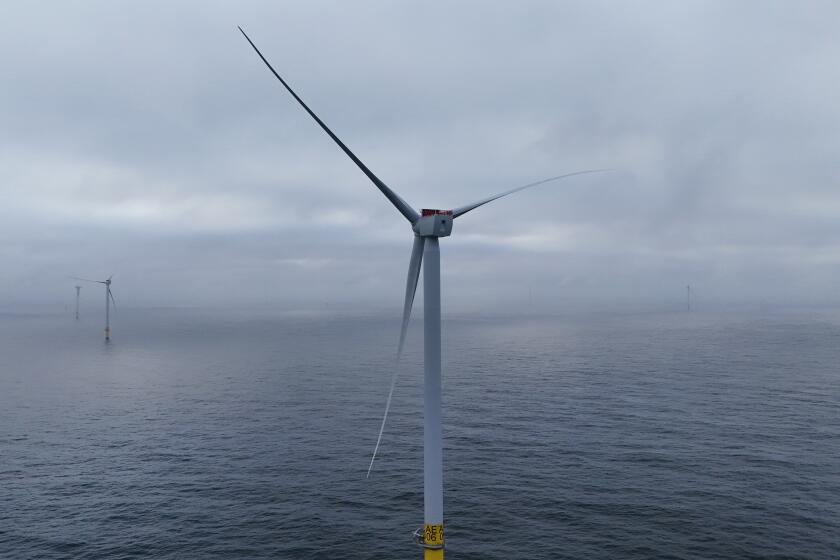
In yet another blow to the beleaguered offshore wind industry, the Trump administration said Wednesday it will pay developer Invenergy $765 million to walk away from four U.S. wind leases, including one off the coast of California, and invest instead in geothermal and fossil fuel projects.
Under the agreement, Chicago-based Invenergy will “voluntarily terminate” its lease off the coast of Morro Bay, as well as a lease in the New York Bight and two off the Gulf of Maine, and instead redirect the millions toward natural-gas-fired power plants in Indiana, Wisconsin, Iowa, Kansas and Missouri and geothermal power generation projects in the western U.S., according to the U.S. Department of Energy.
Geothermal technology taps into pockets of heat rising from the center of the earth, which is then used to spin turbines to generate power.
Advertisement
The $765 million represents a partial reimbursement to the companies for what they paid for the leases, which were awarded under the Biden administration. Wind lease areas are stretches of ocean designated by the U.S. government for potential offshore wind development.
Trump administration paying wind developers to walk away from California offshore leases
In the second such highly unusual move, the Trump administration is paying to make wind power go away
April 27, 2026
It marks the third such announcement from the Trump administration this year. In March, the Interior Department announced a $1 billion deal with the French firm TotalEnergies to abandon its wind leases off the North Carolina and New York coasts. In April, it struck an $885 million deal with Golden State Wind and Bluepoint Wind to end their leases off the coast of California, New Jersey and New York, with both agreeing to instead invest in “reliable conventional energy projects.”
The latest move leaves only three offshore wind leases intact off the coast of California — one off Morro Bay and two off the coast of Humboldt Bay. Last year, the Trump administration also terminated nearly half a billion dollars local officials were planning to use for the offshore wind effort in Humboldt.
The president and his advisers have repeatedly criticized offshore wind as intermittent, unreliable and unsightly. Trump has focused instead on accelerating U.S. fossil fuel production, including a recent $700 million investment in new and existing coal plants and the first-ever coal export terminal on the West Coast in Oakland.
“President Trump is committed to unleashing affordable, reliable American energy for our country’s communities and putting the American people first through common-sense action,” said Interior Secretary Doug Burgum in a statement. “Under President Trump, companies are shifting investment back toward dependable, secure energy infrastructure that can power our economy and lower utility costs.”
Burgum also described offshore wind projects as threats to national security — a notion many experts have dismissed.
Advertisement
Defying Trump, California continues to bet big on offshore wind
The Port of Long Beach aims to become an assembly hub for floating offshore wind turbines, while the state awaits a more favorable federal administration for their deployment.
May 24, 2026
But the move continues to undermine California’s offshore wind ambitions. The state has a target of 25 gigawatts of offshore wind power by 2045, and officials say it could play an important role in a diversified energy portfolio along with solar power and battery energy storage.
Invenergy’s California lease area, known as Even Keel Wind, covered about 80,000 acres roughly 20 miles off the coast and was estimated to support 2 gigawatts of offshore wind capacity, enough to power about 1 million homes.
Environmental groups and Democratic lawmakers are likely to challenge the latest agreement after calling into question the legality of the previous deals earlier this year. State officials in California are already investigating the deal with Golden State Wind; the California Energy Commission has subpoenaed details about the payout.
“Donald Trump is using your tax dollars to make America more dependent on dirty, volatile fossil fuels,” said Rep. Jared Huffman (D-San Rafael) on Wednesday. “He is paying energy companies to kill homegrown offshore wind that will put electricity on the grid, lower energy bills, and create good jobs, and he is funneling that money straight back to fossil fuel, leaving families at the mercy of every price spike and global shock. It is hard to imagine a more backwards use of taxpayer money.”
Eddie Ahn, executive director of Brightline Defense, a nonprofit environmental justice and policy advocacy group, said similarly that the deal is “yanking” jobs and investments away from Californians. “California should investigate this second backroom deal to the full extent of the law and demand accountability for this blatant misuse of taxpayer funds,” he said.
Officials with Invenergy — the largest privately held independent power producer in North America — said the agreement was motivated by soaring demand for electricity, which is expected to grow as much as 40% in the next decade driven largely by AI data centers. The company is “focused on delivering reliable, affordable energy for our customers and supporting disciplined investment at scale,” said Daniel Runyan, senior vice president for development.
A source familiar with the company said the decision to walk away from offshore wind is also a reflection of policy and market realities that are inescapable right now. Natural gas and geothermal are both seen as faster ways to meet demand, the source said.
Advertisement
The company is looking to start exploratory drilling for geothermal later this year in the Western U.S., the source said, including potential sites in California, Idaho, Nevada and other states.
More to Read

Voices
Hiltzik: Trump’s ‘weird war’ on wind power will jeopardize our energy future and cost Americans billions
May 14, 2026

Offshore wind farms rise along Rhode Island’s coast, even as Trump tries to stop them
April 27, 2026

Inside California’s audacious bid to build the world’s deepest floating wind farm
April 9, 2026
Show Comments
Climate & Environment California Business Climate Change
Follow Us
Hayley Smith is an environment reporter at the Los Angeles Times focused on climate policy, technology and solutions. She previously worked on the breaking news team. Originally from Miami, she holds a master’s degree in journalism from USC.
More From the Los Angeles Times

Climate change is making once-rare coastal floods more likely, study says
June 17, 2026

Solar surpasses coal in historic shift for U.S. electricity mix
June 17, 2026

Lawmakers fight to stop dismantling of $386-million ocean observation network by Trump administration
June 17, 2026

El Niño turns crumbling California pier into climate battleground over what to save — and who pays
June 16, 2026
Podcasts

Rebuilding L.A.: How One Altadena Neighborhood Builds Back, Piece By Piece
It turns out you can burn down a neighborhood and not destroy a community. We’ve seen evidence of this all across L.A. and so we will head back to one neighborhood that’s a good example of that bond: West Poppyfields Drive in Altadena.

Boiling Point: Smoglandia Pt 1: L.A. SMOG – VERY OLD-SCHOOL
Modern LA earned its first smoggy nickname 450 years ago, as the “bay of smokes.” At the La Brea tar pits, we take a short walk through a long history with curator Regan Dunn, who explains how and why the first Angelenos would have set fires that filled the broad bowl of LA and foretold the curse of smog.
Advertisement
Read Original at Los Angeles Times →