
Trendingnow
1
2
MacKenzie Scott alone accounted for one-third of America's $19.2 billion in megagifts last year
3
1
2
MacKenzie Scott alone accounted for one-third of America's $19.2 billion in megagifts last year
3
Vinod Khosla: AI’s energy crisis has a fix — and it doesn’t need the grid
By Vinod Khosla Vinod Khosla
Down Arrow Button Icon
By Vinod Khosla Vinod Khosla
Down Arrow Button Icon
June 30, 2026, 8:30 AM ET
Vinod Khosla is the founder of Khosla Ventures and was the first institutional investor in OpenAI.
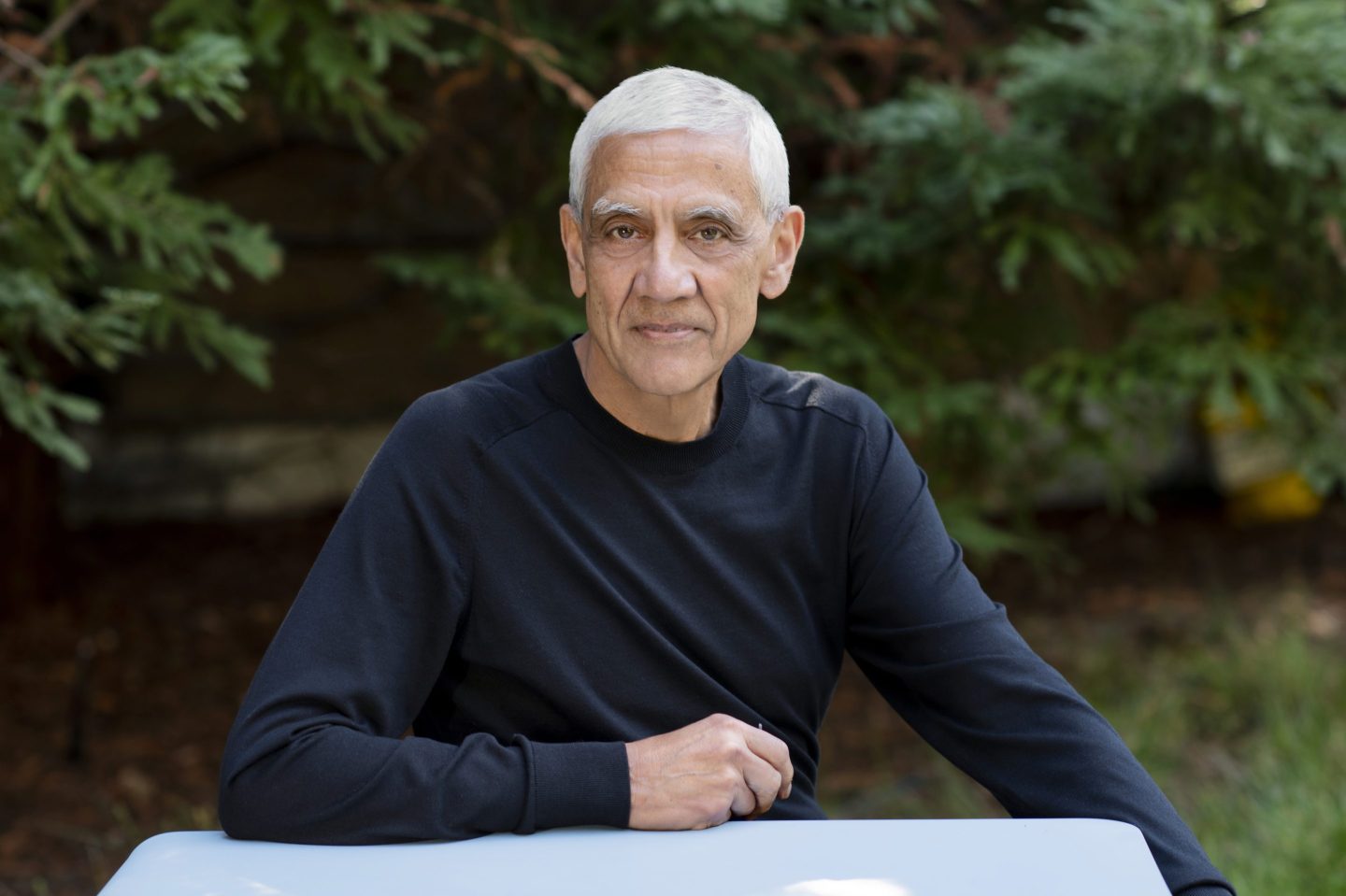
Vinod Khosla, founder of Khosla Ventures.courtesy of Khosla Ventures
Add Fortune on Google for similar content.
Add us on Google
Add us on Google
A single large AI data center now consumes as much electricity as a city of 80,000 people. The companies building them are putting up hundreds simultaneously, in places the grid was never designed to reach, on timelines that utility companies, with their seven year queues for new connections, simply can’t comprehend. The AI revolution is stretching the nation’s electricity grid to its limits. So why not unplug?
Recommended Video
So it’s not that there’s anything wrong with the US power grid. It simply can’t provide what the country needs right now at the scale, flexibility and speed required. More than 2,600 gigawatts of proposed projects are waiting to connect to a grid whose total installed capacity is less than half that number.
I truly believe that AI will create a future of abundance so profound it is almost unimaginable. But that future runs on power—enormous amounts of power, delivered to where compute is being built, when it’s needed, at a scale the existing infrastructure will never be able to meet.
The industry’s response so far has been to reach for the same gas turbines and engines that have powered the grid for fifty years. While widely understood, and deeply wrong for this moment. When you need power in months and the interconnection queue stretches seven years, you reach for what is available. But building the AI century on fifty year old combustion technology is like building the internet on dial-up. It works until it does not, and the companies that accept that constraint will spend the next decade competing against the ones that did not.
There is a better solution. It’s one that has been commercially deployed for years, and which has the potential to change the economics of where and how AI infrastructure gets built. Linear generators convert fuel directly into electricity through a low-temperature, flameless reaction. There’s no combustion and no complex mechanical parts.
They can run on natural gas, biogas, hydrogen, propane or any blend of those fuels, and switch seamlessly between them depending on the supply that’s available. They produce almost zero nitrogen oxide emission, meeting the most stringent air quality standards in the country. They can be scaled in modular increments from single digit to hundreds of megawatts. They can be deployed in months instead of years. And they can operate completely independently of the grid from day one, but then support the grid once it’s available.
A data center powered by linear generators doesn’t need to wait in the interconnection queue. It’s not dependent on a substation upgrade scheduled for 2029. Power can be generated right where it’s needed, and scaled as demand grows. The grid becomes a complement, not a prerequisite—connect when it’s ready, or run without it indefinitely.
Technology converts scarcity into abundance. Right now, the bottleneck is not electricity. It’s grid capacity, getting that power to the right place at the right time. Linear generators can help address power scarcity. The stakes here go beyond data centers. Every sector that defines American competitiveness, from manufacturing and defense to healthcare and logistics, runs on power. The country that figures out how to generate abundant, clean, locally deployed energy the fastest will be well positioned in the AI race and the broader competition for economic growth. You can build anywhere on earth: the Mojave Desert, rural Ohio, or on a brownfield site in any state with cheap land and available gas, without asking permission from a regulatory system designed for a century when speed didn’t matter.
Already, percent of data center executives say they’re either investing or planning to invest in on-site generation. Soon they’ll be in the majority. Significant linear generation capacity is already in various stages of development and commercial operation, and this technology is being adopted by major companies and data center developers who cannot wait for the grid to catch up.
I have a simple framework I have applied to every investment I have made for forty years. The companies that build what the next era actually needs, rather than optimizing what the last era produced, are the ones that define the future. That’s why I backed OpenAI before the world understood what it was, and why I backed solar when every utility company in America said distributed generation would never work at scale. The telephone companies that tried to carry internet traffic over voice infrastructure did not build the internet. Those that are trying to serve AI demand through a transmission system designed for a different century will not power the AI era.
The companies building AI infrastructure on reliable, fuel-flexible, locally deployed generation that requires no grid connection will have a meaningful structural advantage over competitors waiting for a substation upgrade. They can build faster, build in more locations, and build cleaner than fifty year old gas engines and turbines can deliver. Even critics of new infrastructure will come around because of the jobs these projects will create. Investors should be watching this space closely.
The infrastructure decisions being made right now will shape the competitive landscape of AI for the next twenty years. The window between when a new architecture becomes available and when the market broadly adopts it is where significant opportunities emerge. I know because I have seen it before, in solar, in computing, in intelligence itself.
That window is open right now in energy. The technology exists. It is already deployed. The only question is who builds the future on it first.
The opinions expressed in Fortune.com commentary pieces are solely the views of their authors and do not necessarily reflect the opinions and beliefs of Fortune .
Vinod Khosla is the founder of Khosla Ventures and was the first institutional investor in OpenAI.
About the Author
By Vinod Khosla
See full bioRight Arrow Button Icon
Add Fortune on Google for similar content.
Add us on Google
Latest in Commentary

Netflix could turn NBC into its biggest bet yet — and this time, the math actually works
By Jeffrey Sonnenfeld and Steven TianJune 30, 2026
6 hours ago

I grew BDO from $600 million to $3.4 billion. Here’s the 3-part formula that made it possible
By Wayne BersonJune 30, 2026
9 hours ago
Vinod Khosla: AI’s energy crisis has a fix — and it doesn’t need the grid
By Vinod KhoslaJune 30, 2026
9 hours ago
Commentary 250 Years of Innovation
By Marc AndersenJune 30, 2026
10 hours ago

Commentary 250 Years of Innovation
By Amanda McMasterJune 30, 2026
11 hours ago

Top climate tech exec: Europe is sweating through a heat crisis America solved decades ago
By Taco EngelaarJune 30, 2026
15 hours ago
Most Popular

By Sydney LakeJune 29, 2026
1 day ago

MacKenzie Scott alone accounted for one-third of America's $19.2 billion in megagifts last year
By Sydney LakeJune 25, 2026
6 days ago

By Preston ForeJune 27, 2026
3 days ago

By Catherina GioinoJune 29, 2026
24 hours ago
By Catherina GioinoJune 28, 2026
3 days ago

Current price of oil as of June 29, 2026
By Joseph HostetlerJune 29, 2026
1 day ago
Read Original at Fortune →